Explainer · Trading Basics
The bid-ask spread: the cost you pay before fees
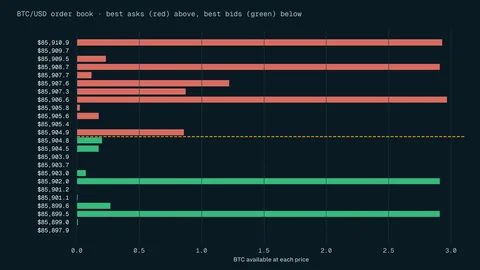
Every market shows two prices, not one. The gap between them is a cost you pay on every round trip, even on a platform that advertises zero commission.
Quick answer
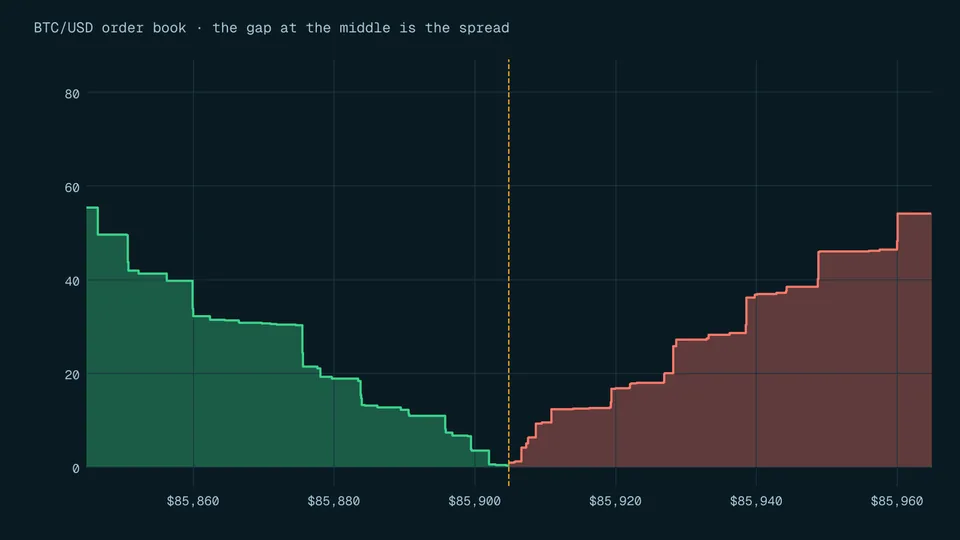
The bid is the highest price a buyer will pay; the ask is the lowest price a seller will accept. The difference is the spread [1]. If you buy at the ask and sell at the bid straight away, you lose the spread, before any fees.
Key points
- The bid is almost always lower than the ask, and the gap is called the spread [1].
- Buying at the ask and selling at the bid costs you the spread on every round trip (calculated).
- Illiquid investments often have wide spreads, which raise the buy price or lower the sell price [3].
- Spreads can widen outside regular hours, when liquidity is lower and volatility higher [5].
- A small spread repeated hundreds of times becomes a large cost (calculated).
On this page
What is the bid-ask spread?#
Any market you trade shows two prices. The SEC defines the bid as the highest price a buyer will pay for a given number of shares at that moment, and the ask (also called the offer) as the lowest price at which a seller will sell [1]. The bid is almost always lower than the ask, and the difference between them is called the spread [1].
For you as a beginner, the practical meaning is simple. If you buy now, you usually pay the ask. If you sell now, you usually receive the bid. FINRA says a market order generally executes at or near the current bid or ask [2]. So the moment you open a trade, it is worth a little less than you paid for it. The short versions of these words are in our glossary entries for bid, ask and spread.
Why do you start every trade slightly behind?#
Because you buy at the higher of the two prices and sell at the lower one. To break even on the example above, the bid has to climb from $19.98 to $20.02, the price you paid. That is a 0.2% rise in the bid before you have made a cent (calculated).
FINRA puts it plainly: large bid-ask spreads can reduce returns by increasing the buy price or lowering the sell price [3]. A study of 66,465 U.S. households trading stocks in 1991 to 1996 estimated an average round-trip cost of about one percent for the bid-ask spread, on top of about three percent in commissions [4]. Those figures are from the 1990s and costs differ today, but every round trip still crosses the spread.
What makes a spread wider or narrower?#
Mostly liquidity: how easily you can buy or sell at a fair price when you want to. FINRA says securities with higher trading volume are generally more liquid, and that illiquid investments often have a wide bid-ask spread [3]. FINRA's rule on extended-hours trading gives the reason in simple terms: the more orders available in a market, the greater the liquidity, and the more likely you are to pay or receive a competitive price [5].
Two situations make spreads wider. The first is trading outside regular hours. FINRA requires brokers to warn customers that lower liquidity and higher volatility in extended hours may result in wider than normal spreads [5]. The second is market stress: during crises, investors move towards the most liquid securities, and illiquid ones can become even less liquid [3].
One caution from FINRA: a narrow spread can indicate good liquidity, but it does not give a complete picture on its own [3]. The quote only covers a specific number of shares, so a larger order may not get the price you saw [6].
| Situation | Bid / ask | Spread | Spread % of midpoint | Shares | Lost on instant round trip |
|---|---|---|---|---|---|
| Heavily traded stock | $19.98 / $20.02 | $0.04 | 0.2% | 50 | $2.00 (0.2%) |
| Same stock, after hours | $19.90 / $20.10 | $0.20 | 1.0% | 50 | $10.00 (1.0%) |
| Thinly traded stock | $4.75 / $5.25 | $0.50 | 10.0% | 200 | $100.00 (9.5%) |
Quotes are an example, not market data. The percentage in the last column is the loss as a share of the amount paid. Wider spreads in thin and after-hours markets are described by FINRA [3] [5].
Who earns the spread?#
Someone is on the other side of your trade. The SEC explains that a broker may fill your order from the firm's own inventory, and that the firm may make money on the spread [6]. FINRA lists markups and spreads among the fees investors pay when a firm sells from its own inventory [7].
In over-the-counter forex the dealer is your counterparty: it is the seller when you buy and the buyer when you sell, and the CFTC notes the dealer makes money when you pay fees, spreads or commissions [8]. That does not make the spread a scam. It is the price of trading immediately. But it does mean a "zero commission" label tells you nothing about the spread you will pay. Our guide to how brokers make money covers the other ways firms earn.
How much does the spread cost if you trade often?#
The spread is paid on every round trip, so frequency matters more than the size of any one spread. The chart assumes each round trip costs 0.2% of the money traded, the same as the heavily traded stock above, and that prices otherwise stay flat. Each cost is taken from a smaller balance, so the losses compound. At 12 round trips a year (monthly) about 2.37% of the money is gone; at 52 (weekly) 9.89%; at 250 (about one each trading day) 39.38%; and at 1,250 (about five a day) 91.81% (all calculated).
- Example spread
- $0.04$20.02 ask - $19.98 bid, calculated
- As a share of price
- 0.2%of the $20.00 midpoint, calculated
- Cost of one 500-share round trip
- $20500 x $0.04, calculated
- Historical estimate
- about 1% per round tripU.S. households, 1991 to 1996 [4]
How can you check the spread before you trade?#
- Look at both prices, not one
Find the bid and the ask on the order screen. If the platform shows only one price, find where it shows separate buy and sell prices before you trade.
- Turn the gap into a percentage
Divide the spread by the midpoint price. $0.04 on a $20 stock is 0.2%; $0.50 on a $5 stock is 10% (calculated).
- Check the time
Outside regular hours spreads may be wider than normal [5]. If you can wait for the main session, compare.
- Use a limit order when the gap is wide
A limit order sets the worst price you accept, though it may not fill [9]. See market, limit and stop orders.
- Count how often you will pay it
Multiply the spread by the number of round trips you expect. If the total is a big share of what you hope to make, trade less often.
Mistakes beginners make with the bid-ask spread#
- Believing zero commission means free
A firm can earn on the spread even when it charges no commission [6]. You still pay it on every round trip.
- Reading the chart price as your exit price
If you hold a position, you sell at the bid, which is below the ask you paid. Your open trade is usually slightly negative from the start.
- Trading thin markets with market orders
Illiquid investments often have wide spreads [3]. A market order pays whatever the ask is, however wide.
- Ignoring after-hours conditions
Lower liquidity and higher volatility outside regular hours may mean wider spreads and worse prices [5].
- Forgetting that frequency multiplies cost
One small spread looks harmless. Hundreds of them can take a large share of the account, as the chart above shows.
Frequently asked questions#
Is the bid-ask spread a fee?
It is not usually listed as a fee, but it works like one. You buy at the higher price and sell at the lower one, and a broker's firm may make money on that difference [6].
Why is the ask always higher than the bid?
The bid is the most a buyer will pay and the ask is the least a seller will accept, so the bid will almost always be lower [1].
Does a narrow spread mean an investment is safe?
No. FINRA says a narrow spread can indicate good liquidity but does not give a complete picture on its own [3]. It says nothing about how far the price itself can fall.
Do forex and crypto have spreads too?
Yes, any market quoted with a buy and a sell price has one. The CFTC notes that in forex the dealer is your counterparty and earns when you pay spreads [8]. Sizes vary by platform and time, so check before you trade.
The bottom line#
The spread is the first cost of every trade and the easiest one to overlook. Look at both prices, turn the gap into a percentage, avoid thin and after-hours markets when you can, and count how many times you will pay it. Then add commissions and other costs with our trading cost calculator, and read the risk disclosure before trading anything with leverage.
Sources
- Bid Price/Ask Price (Investor.gov glossary).
- Order Types.
- Understanding Market Liquidity and Your Investments.
- Trading Is Hazardous to Your Wealth: The Common Stock Investment Performance of Individual Investors.
- 2265. Extended Hours Trading Risk Disclosure (FINRA Rules).
- Trade Execution: What Every Investor Should Know.
- Fees and Commissions.
- Customer Advisory: Eight Things You Should Know Before Trading Forex.
- Understanding Order Types (Investor Bulletin).
Education only. This page is not investment, tax or legal advice. Trading and crypto can lose you money. See our risk disclosure.