Explainer · Trading Basics
How do brokers make money from your trades?
Every broker is a business, and "commission-free" only tells you which fee is missing. Knowing where the money comes from shows you what each trade really costs and where the broker's interests can pull against yours.
Quick answer
Brokers earn from commissions, the bid-ask spread [2], payments from market makers for routing your orders, interest on margin loans and cash, and other fees [1]. A forex or CFD dealer can also profit when you trade more often or lose [4].
Key points
- Free trading does not mean free investing: firms with no commission earn in other ways [2].
- The spread is a cost you pay on every round trip, even when the commission is zero.
- Payment for order flow can create a conflict of interest for the broker [1].
- With an OTC forex dealer, the dealer is the other side of your trade [4].
- A $4 cost per round trip, 250 times a year, is $1,000, or 20% of a $5,000 account (calculated).
On this page
Where does a broker's income come from?#
A broker sits between you and the market. It takes your order, finds someone to trade with, holds your cash and positions, and sometimes lends you money. It charges for those services, sometimes openly as a fee and sometimes less visibly through the price you get.
In a 2021 report, SEC staff listed the revenue sources that some US retail brokers kept or increased after cutting commissions: payment for order flow, advisory and managed accounts, interest on margin loans and cash deposits, securities lending, and fees for additional services [1]. FINRA adds the classic charges: commissions for buying and selling, and markups or spreads when a firm sells you something from its own inventory [2].
| Source | How it works | Where you see it |
|---|---|---|
| Commission | A fee for buying or selling a security [2] | On the trade confirmation and the fee schedule |
| Spread or markup | The gap between the buy and sell price, earned when the firm fills you from its own inventory [3] | Inside the price, not as a separate line |
| Payment for order flow | A market maker pays the broker for sending it your order [1] | In order-routing disclosures, not on your statement |
| Interest | Interest on margin loans and on the cash you leave uninvested [1] | Margin rate and cash rate pages |
| Dealer trading profit | An OTC forex dealer takes the other side of your trade [4] | In the client agreement and risk warnings |
| Other fees | Advisory fees, options commissions and similar charges [2] | The full fee schedule |
Not every broker uses every source. The mix depends on the firm, the product and the country.
What does commission-free trading actually mean?#
It means one fee is set to zero. FINRA is direct about it: free trading is a way to attract customers, but it does not mean free investing [2]. Firms that offer free trades make money in other ways, such as interest from margin loans, robo-advisory fees and commissions on options or other securities [2].
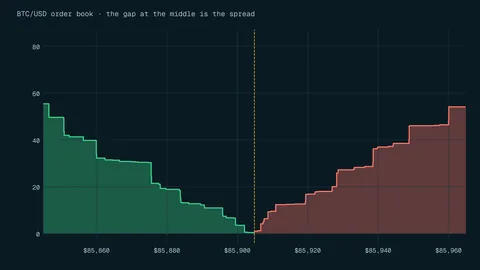
The cost you meet first is usually the spread. The bid is the highest price a buyer will pay, the ask is the lowest price a seller will accept, and the difference between them is the spread [5]. If you buy at the ask and sell at the bid straight away, you lose the spread even though the price did not move. Our guide to the bid ask spread covers this in more depth.
The same idea applies to currencies. With an illustrative EUR/USD quote of 1.1000 bid and 1.1002 ask, opening and closing a 10,000-euro position at once costs 10,000 x 0.0002 = $2.00 (calculated). Bigger positions pay a bigger spread in money terms.
How does payment for order flow work?#
When you send a stock order, your broker decides where it goes. Off-exchange market makers typically pay retail brokers for the right to trade with their customers' orders, and this is called payment for order flow [1]. In a 2013 investor guide the SEC described these payments as perhaps a penny or more per share [3]. A broker can also fill your order from its own inventory, which is called internalization, and may earn the spread [3].
The last step is where the conflict sits. SEC staff explain that a market maker may let the broker decide how to split the payment between improving customers' prices and keeping it, and that these payments can create a conflict of interest [1]. The same report cites an SEC enforcement case in which Robinhood took roughly a 20/80 split between price improvement and payment for order flow, against a typical 80/20 rate paid to other brokers [1].
Price improvement is real money. In the SEC's example, a market order to sell 500 shares quoted at $20 that fills at $20.05 brings in $10,025, which is $25 more than at the quote [3]. Brokers that route orders must also disclose each quarter the market centers that receive a significant share of their orders [3].
- Payment per share (SEC, 2013)
- a penny or more [3]the SEC's own wording, not a current figure
- Price improvement in the SEC example
- $25 on 500 shares [3]fill at $20.05 instead of $20
- Split in the Robinhood case
- about 20/80 [1]price improvement vs payment for order flow
- EU exemption allowed until
- 30 June 2026 [6]latest date a member state could exempt its firms
Rules differ by region. ESMA said in 2021 that receiving payment for order flow was in most cases unlikely to be compatible with EU rules [7], and an EU regulation adopted in 2024 prohibits investment firms from receiving such payments for retail client orders, with a national exemption allowed until 30 June 2026 [6]. For the full picture, see our page on payment for order flow.
What changes when the broker is the other side of your trade?#
Some brokers do not send your order to a market at all. In over-the-counter forex, the CFTC warns that you are trading only against your dealer: when you buy, the dealer is the seller, and when you sell, the dealer is the buyer [4]. The platform is not a live exchange, and you are limited to the prices and conditions the dealer offers [4].
The CFTC also states plainly that the dealer makes money when you trade more frequently, lose money, or pay fees, spreads or commissions [4]. Contracts for difference (CFDs), which the UK regulator describes as complex, leveraged derivatives sold through online platforms, raise the same question of who is on the other side [8].
Leverage multiplies both the trading volume and the risk. The CFTC's example: a 2 percent margin requirement lets you open a $100,000 position with $2,000 [4]. A 1% move against that position is $1,000, which is half of the $2,000 deposit (calculated). The dealer earns its spread on the full $100,000, not on your $2,000.
How much do small trading costs add up to?#
A few dollars per trade sounds harmless. The cost grows with how often you trade, not with how well. In a study of 66,465 US households at a discount broker from 1991 to 1996, the households that traded most earned 11.4% a year while the market returned 17.9% [10]. The authors estimated a round-trip cost of about 1% for the spread and about 3% in commissions [10]. SEC staff noted in 2021 that retail brokers had reduced commissions [1], so treat those figures as history, not as current prices.
The table keeps one cost fixed, $4 per round trip (the spread from the example above), and changes only how often you trade on a $5,000 account.
| Round trips per year | Total cost | Share of account |
|---|---|---|
| 12 | $48 | 0.96% |
| 52 | $208 | 4.16% |
| 250 | $1,000 | 20% |
Before any commission, financing or price movement. The account must gain this much just to break even.
Ongoing fees compound in the same way. FINRA cites an SEC illustration in which a 1 percent annual fee for 20 years on a $100,000 investment earning 4 percent costs $28,000 [2]. Try your own numbers in the trading cost calculator.
How can you check how your broker is paid?#
- Read the full fee schedule
Look past the headline "zero commission" for spreads or markups, options commissions, account fees and currency conversion charges.
- Find out who is on the other side
Check the client agreement. If the firm is the counterparty, as OTC forex dealers are, it earns when you lose or trade more [4].
- Look at order routing
US brokers that route orders publish quarterly reports on where they send them [3]. Look for payment for order flow and price improvement figures.
- Check interest rates both ways
Note what you pay to borrow on margin and what, if anything, you earn on idle cash. Both are revenue lines for many brokers [1].
- Ask directly
FINRA encourages investors not to be shy about asking professionals how they are paid [2]. A clear answer in writing is a good sign; a vague one is a warning.
- Confirm the firm is regulated
Follow our guide on how to check if a broker is regulated and use the official register for your country.
Mistakes beginners make with broker costs#
- Believing "free" means no cost
A zero commission still leaves the spread, interest and other fees. FINRA says free trading does not mean free investing [2].
- Ignoring the spread on small trades
The spread is paid on every round trip. Trading often multiplies it, as the table above shows.
- Assuming the platform is a market
With an OTC forex dealer you trade at the dealer's prices, not on a live exchange [4].
- Chasing sign-up bonuses
Bonuses are paid to get you trading. UK rules require CFD firms to stop offering cash or other inducements to trade [8], which shows how regulators view them.
- Leaving cash idle without checking the rate
Interest on customer cash is a revenue line for some brokers [1]. Know what your uninvested cash earns, if anything.
Frequently asked questions#
Is a commission-free broker really free?
No. Firms with free trades earn from other sources such as margin interest, advisory fees and options commissions [2], and you still pay the spread on every trade.
Is payment for order flow bad for me?
Does my forex broker want me to lose?
If the dealer is your counterparty, the CFTC says it makes money when you lose, trade more often or pay fees and spreads [4]. That is a conflict you should know about, whatever the dealer's intentions.
Which broker cost matters most for a beginner?
It depends on how you trade. Frequent traders pay the spread many times, while long-term holders feel ongoing fees more. Write down every cost line before you choose, and run your expected trading pattern through a cost calculator.
The bottom line#
Brokers earn from commissions, spreads, payment for order flow, interest and, in some products, from being the other side of your trade. None of that is hidden if you know where to look: the fee schedule, the client agreement and the order-routing reports. Count every cost before you trade, keep your trading frequency in check, and read the risk disclosure before using leverage. For the other basics, start at the trading basics for beginners hub.
Sources
- Staff Report on Equity and Options Market Structure Conditions in Early 2021.
- Fees and Commissions | FINRA.org.
- Trade Execution: What Every Investor Should Know.
- Customer Advisory: Eight Things You Should Know Before Trading Forex.
- Bid Price/Ask Price (Investor.gov glossary).
- Regulation (EU) 2024/791 of the European Parliament and of the Council of 28 February 2024 amending Regulation (EU) No 600/2014.
- ESMA warns firms and investors about risks arising from payment for order flow.
- PS19/18: Restricting contract for difference products sold to retail clients.
- ESMA agrees to prohibit binary options and restrict CFDs to protect retail investors.
- Trading Is Hazardous to Your Wealth: The Common Stock Investment Performance of Individual Investors.
Education only. This page is not investment, tax or legal advice. Trading and crypto can lose you money. See our risk disclosure.