Glossary
Market order: fast to fill, price not guaranteed
The market order is the default button on most trading apps. It is built for speed, and the price you see when you tap it is not a promise.
A market order is an order to buy or sell at the best available price at the moment it reaches the market. It usually fills quickly, but the price you get is not guaranteed.
Quick answer
A market order buys or sells at the best available price [1]. It generally executes at or near the current bid or ask [3], but the execution price is not guaranteed and often differs from the last price or quote you saw [1].
Key points
- A market order trades at the best available price [1], generally buying near the ask and selling near the bid [3].
- The price is not guaranteed [1]; in fast markets or for large orders it can be worse than the quote [3] [4].
- Use a limit order when the price matters more than speed, accepting it may not fill [1].
On this page
What is a market order?#
The SEC defines a market order as an order to buy or sell a stock at the best available price [1]. The CFTC glossary describes the same idea for futures: an order to buy or sell at whatever price is obtainable when it is entered [2]. FINRA calls it the most common type of investor order, and says it will generally execute at or near the current bid or ask during normal U.S. trading hours, 9:30 a.m. to 4 p.m. Eastern Time [3].
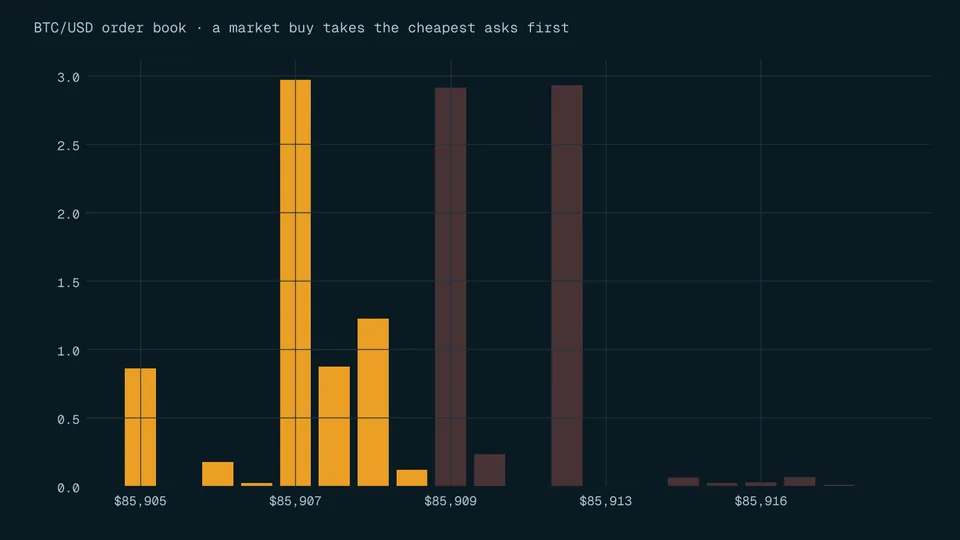
In plain terms: a market buy meets the ask price, a market sell meets the bid price, and the gap between them is the spread you pay for trading immediately.
Why can a market order fill at a different price?#
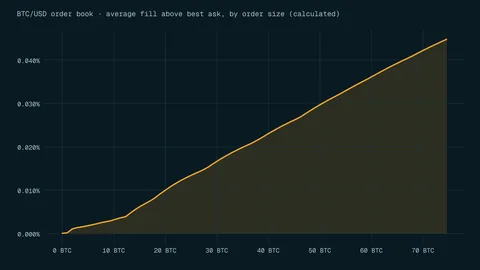
The SEC states that the price at which a market order will be executed is not guaranteed, and that it often deviates from the last-traded price or real-time quote because of demand and the prices of available liquidity at the time of execution [1]. Quotes are good only for a specific number of shares, so a large order can run past the displayed price [4]. FINRA adds that in fast-moving markets you might not get the price you saw [3]. This gap is often called slippage.
| Situation | Effect on a market order |
|---|---|
| Normal hours, busy market | Usually fills at or near the bid or ask |
| Fast-moving market | May not get the price you saw |
| Order larger than the quoted size | May fill partly at worse prices |
| Placed while the market is closed | News can move the price before the open |
When the fill can differ from the quote. Sources: FINRA order types [3], SEC trade execution guide [4].
Can the price ever be better than the quote?#
Sometimes. The SEC gives an example of price improvement: a market order to sell 500 shares quoted at $20 that executes at $20.05 brings $10,025.00, which is $25.00 more than at the quote [4]. You cannot count on it, but it shows that the quote is a starting point, not the final price.
If you need control over the price, a limit order sets the worst price you will accept. Our explainer on market, limit and stop orders compares all three.
Frequently asked questions#
Is a market order always filled?
Should I use a market order outside trading hours?
Be careful. FINRA warns that orders placed outside normal hours face the risk that news or other factors move the price before the market opens again [3].
The bottom line#
A market order buys speed and gives up control of the price. That is fine for small orders in busy markets and risky in fast, thin or closed ones. Check the bid and ask before you tap the button, and use a limit order when the price matters. Read our order types explainer and the risk disclosure.
Sources
Education only. This page is not investment, tax or legal advice. Trading and crypto can lose you money. See our risk disclosure.