Glossary
Limit order: your price or better, or no trade
A limit order swaps one risk for another. You stop worrying about a bad fill and start accepting that the trade may not happen at all.
A limit order is an order to buy or sell at a specific price or better. It controls the price you get, but it is not guaranteed to execute.
Quick answer
A limit order buys or sells only at a price you set or better [1]. A buy limit sets the most you will pay; a sell limit sets the least you will accept [3]. The catch: it is not guaranteed to execute, so you can miss the trade.
Key points
- A buy limit fills only at your limit or lower; a sell limit only at your limit or higher [2].
- It is not guaranteed to execute, so price protection comes at the cost of possibly no trade [1].
- Check how long it stays active: a day order generally cancels at the close; a GTC order lasts until filled or cancelled [1].
On this page
What is a limit order?#
The SEC defines a limit order as an order to buy or sell a stock at a specific price or better [1]. FINRA calls that price the "limit price" [2]. The CFTC glossary puts it from the trader's side: you specify a minimum sale price or a maximum purchase price [3].
The SEC gives a simple case: a limit order to buy ABC at no more than $10 will only execute if the price of ABC is $10 or lower [1].
| Limit order | Market order | |
|---|---|---|
| Controls | The price | The speed |
| Fills | Only at your price or better | At the best available price |
| Main risk | May never execute | Price may differ from the quote |
Limit order versus market order. Sources: SEC order types bulletin [1], FINRA [2].
What happens to a limit order in practice?#
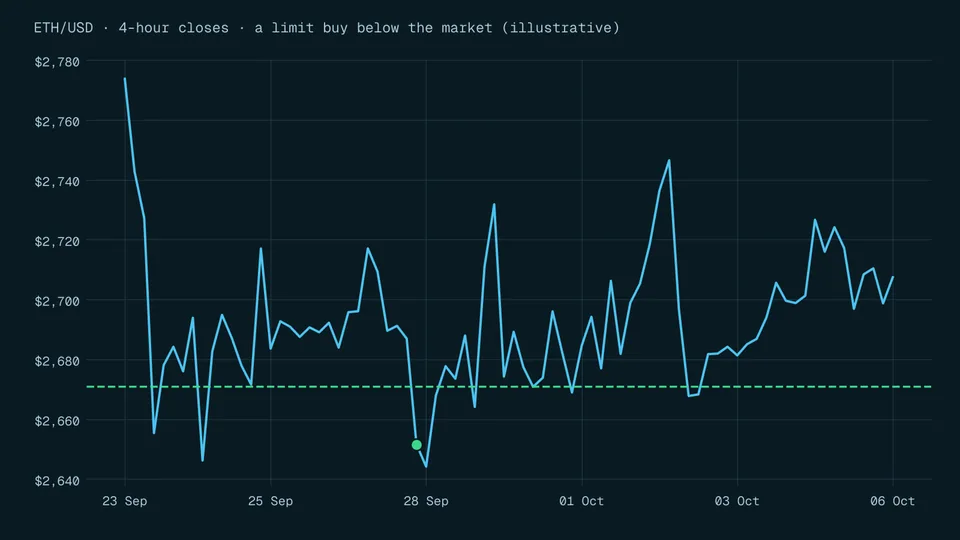
The last case is the cost of a limit order. The SEC states plainly that a limit order is not guaranteed to execute [1]. It can also fill only in part: FINRA's extended-hours rule warns that with lower liquidity an order may be only partially executed, or not at all [4].
Compare this with a market order, which aims to trade now at the best available price but does not promise that price.
How long does a limit order stay active?#
That depends on the time-in-force you choose. The SEC explains that day orders, if not executed, generally cancel at the end of regular trading hours, while a good-til-canceled (GTC) order lasts until it is executed in full or you cancel it [1].
A forgotten GTC order can fill weeks later, after you have changed your mind. Check how long your broker keeps a GTC order open, and review open orders regularly. For how limit orders compare with stops, read our explainer on market, limit and stop orders, and see the ask price entry for the price a buy limit is measured against.
Frequently asked questions#
Can a limit order fill at a better price than my limit?
Yes. The definition is your price "or better" [1]. A buy limit at $10 can fill at $9.95 if a seller offers that price.
Does a limit order protect me from losses?
No. It controls the price at which you enter or exit, not where the market goes after that. FINRA notes that you cannot completely eliminate market and investment risks with any order type [2].
Why didn't my limit order fill when the price touched my limit?
The bottom line#
Use a limit order when the price matters more than getting the trade done. Set the limit, choose day or GTC on purpose, and accept that the order may not fill. Check open orders often so an old one does not surprise you. Our explainer on market, limit and stop orders shows when each type fits, and the risk disclosure covers what no order can prevent.
Sources
Education only. This page is not investment, tax or legal advice. Trading and crypto can lose you money. See our risk disclosure.