Explainer · Crypto Basics
Why is crypto so volatile?
Crypto prices can rise or fall by large amounts in a short time, and regulators in the US, UK and EU all warn about it. This page explains why it happens and what it can do to your money.
Quick answer
Crypto is volatile mainly because its price rests only on supply and demand, with no legal tender status behind it [3], and because trading is driven largely by speculation [8]. Low liquidity, little price transparency and possible manipulation add to the swings [5].
Key points
- US regulators say virtual currencies are more volatile than traditional currencies because their value comes only from supply and demand [3].
- In November 2022 the Federal Reserve reported the market value of selected crypto-assets about 69% below its November 2021 peak [6].
- After a 69% fall you need a gain of about 222.58% just to get back to where you started (calculated).
- Leverage amplifies crypto's price swings into larger gains and losses, and you can lose more than you put in [3].
- A BIS study estimated that 73-81% of retail investors likely lost money on their initial bitcoin investment [10].
On this page
What does volatility mean for crypto?#
Volatility is how much and how quickly a price moves. FINRA describes it as a security, commodity or index fluctuating wildly in a short period of time [1], and adds that the more dramatic the swings, the higher the volatility and the potential risk [2]. Our volatility glossary entry has the short version.
Regulators use strong words about crypto. The US Commodity Futures Trading Commission (CFTC) says virtual currencies are more volatile than traditional fiat currencies [3]. The SEC says investments in crypto asset securities can be exceptionally volatile and speculative [4]. The EU's three financial supervisors list sudden and extreme price movements first among crypto's risks [5].
How far have crypto prices fallen before?#
In its November 2022 Financial Stability Report, the US Federal Reserve wrote that the market value of selected crypto-assets, excluding stablecoins, was about 69 percent below its November 2021 peak [6]. That figure covers a group of selected crypto-assets taken together, not one coin. For comparison, FINRA says a fall of 20 percent or more in a broad market index is generally enough to call it a bear market [1].
Some assets fell much further. TerraUSD, a so-called stablecoin worth about $18 billion before May 2022, was wiped out together with the rest of the Terra blockchain [6]. Our page on stablecoins tells that story.
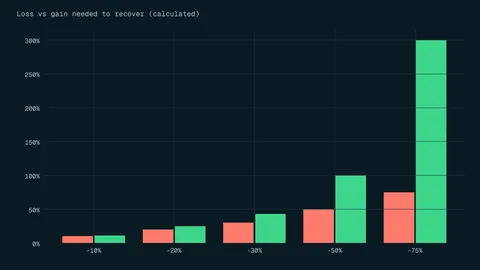
Losses and gains are not symmetric: a 50% loss needs a 100% gain to break even [7]. In general, a fall of x needs a gain of x / (1 - x), which is plain arithmetic. The chart shows what that means at different depths. The full explanation is on why a 50% loss needs a 100% gain.
Why is crypto so volatile?#
Our sources point to several causes that work together. The table lists each one with the regulator that names it.
| Cause | What it means | Named by |
|---|---|---|
| Only supply and demand | No legal tender status; the price is only what buyers and sellers agree on | CFTC |
| Demand-only pricing | When demand changes, nothing else holds the price up | EU supervisors |
| Speculation | Trading driven mainly by bets on where the price goes next | SEC, Federal Reserve |
| Low liquidity | Fewer buyers and sellers, so one large order can move the price | EU supervisors, SEC |
| Poor price transparency and manipulation | Harder to see a fair price, and prices can be pushed around | EU supervisors |
| Mostly unregulated markets | Most cash markets are not supervised by a government agency | CFTC, EU supervisors |
Sources: CFTC [3], EU supervisors' joint warning [5], SEC [8] [4], Federal Reserve [6].
Take them one at a time. The CFTC says a virtual currency's value is completely derived from supply and demand, which is why it is more volatile than fiat currencies [3]. The EU supervisors say many crypto-assets face sudden and extreme price moves because their price often relies solely on consumer demand [5]. The SEC says trading in bitcoin and ether has been substantially driven by speculation, which can lead to heightened volatility [8], and the Federal Reserve called speculation and risk appetite the primary driving forces of crypto prices [6].
Market structure adds to it. The EU supervisors list market manipulation, lack of price transparency and low liquidity as risks [5], and the SEC cites volatility and illiquidity in crypto markets [4]. FINRA explains, for securities, that a large order in a low-volume market is hard to execute quickly [9].
The first two steps come from a Bank for International Settlements (BIS) study of 95 countries: when the bitcoin price rises, more people download and use crypto exchange apps [10]. The last two follow the EU supervisors' point that prices often rely solely on demand [5]. Chasing what already moved has a name; see fomo trading.
What can volatility do to a beginner's money?#
Swings in both directions also cost money on their own. A rise of x% followed by a fall of x% leaves you with a loss [7]: $1,000 up 20% is $1,200, and down 20% from there is $960 (calculated). The bigger the swings, the bigger this drag.
The outcome for real people has not been good. A BIS study of crypto app use in 95 countries from 2015 to 2022 estimated that 73-81% of retail investors had likely lost money on their initial bitcoin investment [10]. The same study found that new users arrived when prices were rising [10].
Why does leverage make crypto volatility more dangerous?#
Leverage means controlling a position larger than the money you put down. The CFTC warns that crypto's volatility is amplified in margined futures, and that traders hit by a move may be forced to refill their margin or close their positions, and may in the end lose more than they put in [3]. See leverage and margin explained before you go near it.
| Leverage | Price falls 5% | Price falls 10% | Price falls 20% |
|---|---|---|---|
| None (1x) | -5% | -10% | -20% |
| 2x | -10% | -20% | -40% |
| 5x | -25% | -50% | -100% |
| 10x | -50% | -100% | -200% |
Before fees and funding costs. A loss above 100% means owing more than you deposited. Before that point you may be forced to add money or have the position closed [3].
How can a beginner limit the damage from crypto volatility?#
Nothing removes the volatility itself. What you can control is how much of your money is exposed to it and whether you are forced to sell at a bad moment.
- Keep the amount small
Decide the most you are willing to lose before you buy. Our position sizing guide shows how to turn that into a number.
- Skip leverage
Leverage amplifies crypto's swings into bigger losses and can cost more than your deposit [3].
- Think about spreading purchases over time
FINRA says dollar-cost averaging can help limit losses in big declines, but often produces lower returns than investing a lump sum and can mean more fees [12]. FINRA writes about investing in general, not crypto. Try the dollar cost averaging calculator.
- Write your plan down before the price moves
Decide in advance what you will do after a 20%, 50% or 69% fall. A plan made in calm conditions is easier to follow than one made during a crash.
Mistakes beginners make with crypto volatility#
- Buying because the price just went up
The BIS found that rising bitcoin prices pull in new users [10], so many buy after a large rise has already happened.
- Thinking a big fall means it must bounce
A 69% fall needs a 222.58% rise to recover (calculated). Some, like TerraUSD, were wiped out instead [6].
- Adding leverage to a volatile asset
At 5x, a 20% move takes all of your money (calculated); the CFTC warns you can lose more than you invested [3].
Frequently asked questions#
Is crypto more volatile than stocks?
Our regulator sources do not publish a single side-by-side figure. The SEC says investments in crypto asset securities can be exceptionally volatile [4], and the CFTC says virtual currencies are more volatile than fiat currencies [3]. For scale: a 20% fall in a broad stock index is generally called a bear market [1], while the Federal Reserve reported the market value of selected crypto-assets about 69% below its peak in November 2022 [6].
Will crypto become less volatile over time?
None of our sources makes that prediction, and we do not either. Plan for the volatility regulators describe today [5], not for a calmer future someone hopes for.
Is volatility always bad?
Are stablecoins a way to avoid crypto volatility?
Only partly. Stablecoins aim for a fixed value, but BIS notes they can trade away from it [13], and TerraUSD was wiped out [6]. Read what are stablecoins first.
The bottom line#
Crypto is volatile because its price rests on demand and speculation, in markets that are often thin and lightly regulated. The Federal Reserve's 69% figure shows how deep a market-wide fall can go, and the arithmetic of recovery shows why such falls are so hard to undo. Keep the amount small, skip leverage, and decide your plan before the next swing. Then use the drawdown recovery calculator and read our risk disclosure.
Sources
- Key Terms for Tough Times: The Vocabulary of Stressed Markets.
- Volatility | FINRA.org.
- Customer Advisory: Understand the Risks of Virtual Currency Trading.
- Exercise Caution with Crypto Asset Securities: Investor Alert.
- ESA 2022 15 - Joint ESAs Warning on Crypto-assets (EBA, ESMA, EIOPA).
- 4. Funding Risks (Financial Stability Report, November 2022), Box 4.1 Digital Assets and Financial Stability.
- Downside financial risk is misunderstood.
- Exchange-Traded Products (ETPs) Providing Exposure to Bitcoin and Ether - Investor Bulletin.
- Understanding Market Liquidity and Your Investments.
- Crypto trading and Bitcoin prices: evidence from a new database of retail adoption (BIS Working Papers No 1049).
- Crypto: The basics | FCA (InvestSmart).
- The Benefits and Limitations of Dollar-Cost Averaging.
- III. The next-generation monetary and financial system (BIS Annual Economic Report 2025).
Education only. This page is not investment, tax or legal advice. Trading and crypto can lose you money. See our risk disclosure.