Explainer · Risk Management
Leverage and margin, explained without the hype
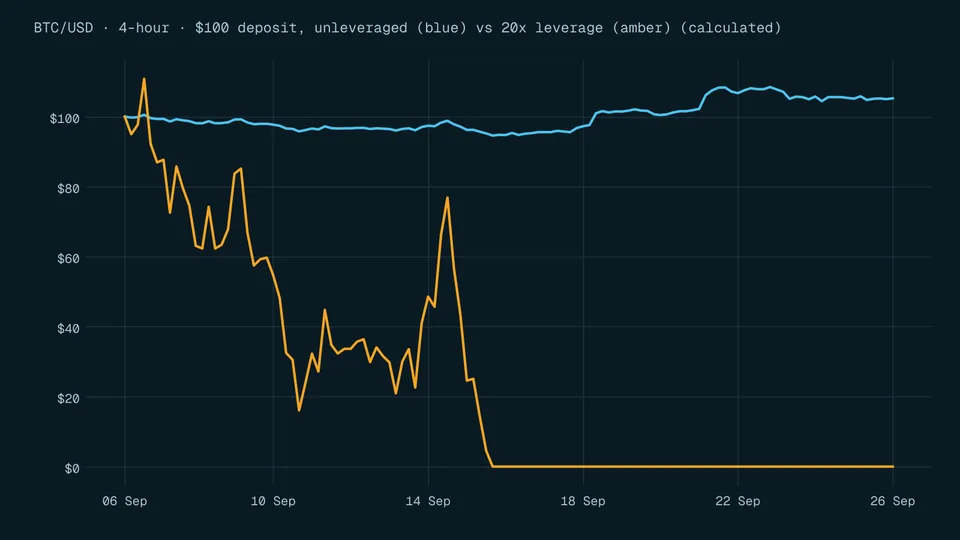
Leverage lets a small deposit control a large position. It multiplies losses exactly as much as gains, and it is the main reason leveraged accounts can be emptied in days.
Quick answer
Margin is the deposit a broker holds as collateral; leverage is how many times larger your position is than that deposit. With 2% margin, $2,000 controls $100,000, so a 2% move against you equals the whole deposit, and you may owe more [3].
Key points
- Margin is collateral, not a fee or a cost of the trade [1].
- Leverage multiplies gains and losses by the same factor [5].
- The adverse move that wipes out your margin is 1 divided by the leverage: 2% at 50:1, 3.33% at 30:1 (calculated).
- When equity falls too far, the broker can close positions without asking you first [8].
- Size trades from the full position value, never from the margin.
On this page
What are leverage and margin?#
Margin is money your broker holds as collateral while a position is open. When you buy shares on margin, the firm lends you cash and uses the assets in your account as collateral [1]. In futures, the same idea means you fund a contract with only a fraction of its full price [2].
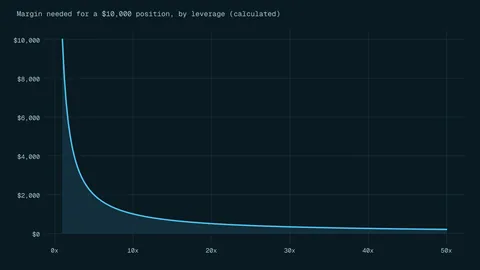
Leverage is the ratio between the size of your position and the margin behind it. Put up $2,000 and control a $100,000 position, and you are using 50:1 leverage (calculated). The CFTC uses exactly this example: a 2 percent margin requirement means you could open a $100,000 forex position with only $2,000 in your account [3].
The two words describe one arrangement from two sides. A lower margin percentage means higher leverage, and higher leverage means a smaller price move is enough to hurt you. Our glossary entries on leverage and margin give the short definitions.
How does leverage turn a small move into a big result?#
Because the gain or loss is worked out on the whole position, but measured against the small deposit. ESMA put it plainly when it restricted CFDs in 2018: leverage can increase possible profits, and it can also increase possible losses [5]. The CFTC says the same about forex: a high degree of leverage amplifies both gains and losses [3].
leverage = position value / margin · change in your deposit (%) = price move (%) × leverage
| Price move against you | Loss in dollars | Share of the $2,000 deposit |
|---|---|---|
| 0.5% | $500 | 25% |
| 1% | $1,000 | 50% |
| 2% | $2,000 | 100% |
| More than 2% | More than $2,000 | More than the deposit |
Position size and margin from the CFTC example [3]. Losses calculated before spreads, commissions and financing, which make every row worse.
Read the chart the other way round and you get the number that matters most: the adverse move that equals your whole margin is 1 divided by the leverage. That is 50% at 2:1, 10% at 10:1, 3.33% at 30:1 and 2% at 50:1 (calculated). At high leverage there is very little room, which is why ESMA warned that high leverage can lead to large losses over a very short time span [5].
What leverage limits do regulators set?#
Regulators write their limits as minimum margin percentages, not as leverage ratios. The ratios in the table are our arithmetic (1 divided by the margin rate), except the overall 30:1 to 2:1 range, which the UK Financial Conduct Authority states itself [6]. The FCA sets higher margin, and so lower leverage, for more volatile assets [6].
| Market and rule | Minimum margin | Maximum leverage (calculated) | Source |
|---|---|---|---|
| UK CFD on a major currency pair | 3.33% | 30:1 | FCA |
| UK CFD on a major stock index, minor pair or gold | 5% | 20:1 | FCA |
| UK CFD on a minor index or other commodity | 10% | 10:1 | FCA |
| UK CFD on a share | 20% | 5:1 | FCA |
| US retail forex, major pairs | 2% | 50:1 | CFTC rule |
| US retail forex, other pairs | 5% | 20:1 | CFTC rule |
| US stocks bought on margin (initial) | 50% | 2:1 | Regulation T |
UK rows: FCA [6]. US forex rows: CFTC rule [7]. US stocks: Regulation T [8]. Rules differ by country and change over time. A broker can ask for more margin than the minimum, and US brokers can raise requirements without advance notice [8].
These limits exist because of what happened without them. In its 2018 decision, ESMA cited national studies in which 76% of client accounts in Cyprus, about 82% of retail clients in Spain and more than 89% of retail investors in France lost money on these products [5]. Each figure comes from a different study and period, so they should not be merged into one range. If you want to understand the product most of these rules target, read what is a CFD.
What happens when a leveraged trade goes against you?#
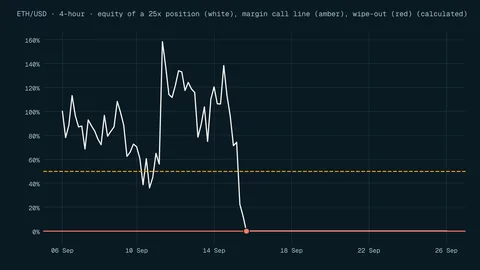
The details depend on the market. For US margin accounts, FINRA's maintenance minimum is generally 25% of the market value of the securities, and many firms set a higher house level of 30% to 40% [8]. The firm can sell your securities without a margin call and without consulting you, and you do not get to choose which ones are sold [1]. For US retail forex, a dealer whose customer's deposits fall short must either collect more money or liquidate the positions [7]. For UK CFDs, the provider must close out positions before your net equity falls below 50% of the margin needed to keep them open [6].
We explain each stage in detail in margin calls and liquidation.
How do you size a trade when leverage is available?#
Ignore the margin and start from the loss you can accept. Leverage decides how little cash the broker needs; it says nothing about how much you should risk. The NFA advises trading only with risk capital, money you can afford to lose, over and above what you need for necessities, emergencies, savings and long-term goals [4].
- Set your amount at risk
Pick a small, fixed share of your risk capital that you would lose if the trade fails. Our position sizing guide shows the formula.
- Work out the full position value
Units times price. This is the number your profit and loss is calculated on.
- Only then look at the margin
Margin needed = position value × margin rate. It tells you the cash the broker will lock up, nothing more.
- Check the effective leverage on your whole account
Divide the position value by your total account equity, not by the margin. This shows how a 1% move changes your real account.
- Find the move that triggers a close-out
Ask how far the price can move before your equity hits the broker's close-out or maintenance level. If ordinary daily moves could reach it, the position is too large.
- Margin at 5%
- $1,0005% UK minimum for a major index [6], amount calculated
- Effective leverage on the account
- 4:1$20,000 / $5,000, calculated
- Loss from a 5% fall
- $1,000 (20% of the account)calculated
- Fall that reaches the 50% close-out level
- 22.5%equity $5,000 down to $500, margin held at the opening $1,000, calculated
- Same fall if only $1,000 is in the account
- 2.5%equity $1,000 down to $500, calculated
The last two rows show why the margin figure misleads beginners. The position and the margin are identical, but the account with only the minimum deposit is closed out by a move nine times smaller (calculated). You can test your own numbers in our margin calculator.
Why do most leveraged retail accounts lose money?#
The official data is consistent. A French AMF study of 14,799 active individual investors in forex and CFDs found that 89% lost money over four years, with an average loss of about €10,900 [9]. An undated CFTC advisory reports that, in the one-year period it covers, about two-thirds of customers at registered US forex dealers lost money once financing charges, fees and other costs were included [3].
Leverage is not the only cause, but it speeds everything up. The FCA requires CFD providers to warn that these products carry a high risk of losing money rapidly due to leverage [6]. The CFTC adds that crypto is more volatile than traditional currencies and that margined futures amplify those swings, which can force traders to add money or close positions and lose more than they put in [2].
Mistakes beginners make with leverage and margin#
- Treating margin as the risk
Thinking "I only put up $1,000, so I can only lose $1,000". The loss is calculated on the full position and can exceed the deposit [3].
- Using the maximum leverage offered
A broker's maximum is a ceiling set by rules, not a recommendation. The higher the leverage, the smaller the move that empties the margin.
- Keeping only the minimum in the account
With no spare equity, a small move reaches the close-out level, as the example above shows.
- Forgetting the cost of borrowing
Financing charges and fees are part of why most forex customers lose money [3]. Holding a leveraged position for weeks costs more than holding it for a day.
Frequently asked questions#
Is leverage the same as borrowing money?
In effect, yes. On a US margin account the firm lends you cash against your securities [1]. With CFDs and futures you post a deposit and are exposed to the full position value, which works the same way for your profit and loss.
Can I lose more than I deposit?
What is a safe level of leverage for a beginner?
No regulator we cite names a safe level. Lower leverage gives a bigger buffer before a close-out, and sizing from your amount at risk matters more than the ratio itself. Read the risk disclosure before using leverage.
What is the difference between initial and maintenance margin?
Initial margin is what you need to open a position, for example 50% for US stocks under Regulation T. Maintenance margin is the minimum equity you must keep, at least 25% under FINRA rules and often 30% to 40% at individual firms [8].
The bottom line#
Margin is the deposit, leverage is the multiplier, and the multiplier applies to losses first. Before any leveraged trade, size it from the loss you can accept, check the effective leverage on your whole account, and find the move that would trigger a close-out. If that move is small, the position is too big. Run your numbers in the margin calculator and read our guide to margin calls and liquidation next.
Sources
- Know What Triggers a Margin Call.
- Customer Advisory: Understand the Risks of Virtual Currency Trading.
- Customer Advisory: Eight Things You Should Know Before Trading Forex.
- Investor Best Practices | NFA.
- European Securities and Markets Authority Decision (EU) 2018/796 of 22 May 2018 to temporarily restrict contracts for differences in the Union in accordance with Article 40 of Regulation (EU) No 600/2014.
- PS19/18: Restricting contract for difference products sold to retail clients.
- 17 CFR 5.9 -- Security deposits for retail forex transactions..
- Investor Bulletin: Understanding Margin Accounts.
- Perspectives on the techniques used to market speculative trading on the Forex and binary options markets.
Education only. This page is not investment, tax or legal advice. Trading and crypto can lose you money. See our risk disclosure.