Calculator
Margin calculator
Enter the full size of a leveraged position and the leverage you plan to use. The calculator shows how much margin it ties up, how small a price move would use up all of that margin, and what a move of your choice would cost.
Quick answer
Margin = position size / leverage. A $10,000 position at 30:1 needs $333.33 of margin, and a 3.33% move against you equals the whole margin (calculated). Losses can exceed your deposit [2], and UK retail CFD positions are closed out earlier, at 50% of required margin [3].
This calculator needs JavaScript. The formula and a worked example below show the same calculation by hand.
Key points
- Leverage changes how much of your money a position ties up, not how many dollars a price move costs.
- The move that wipes out the margin is 100% divided by the leverage: 3.33% at 30:1, 2% at 50:1 (calculated).
- UK rules set retail CFD margin by asset, from a 3.33% minimum on major currency pairs to 20% on shares [3].
On this page
How does the calculator work?#
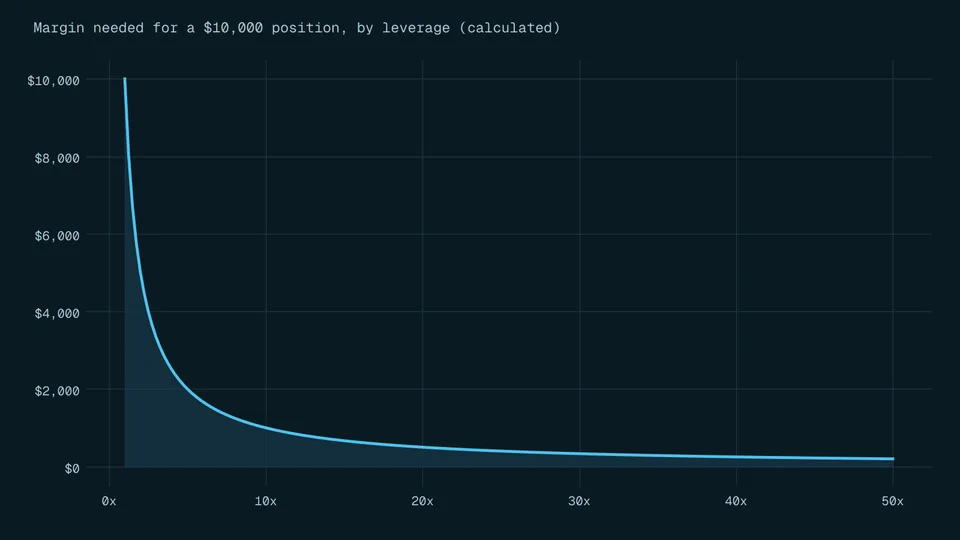
A leveraged position has two sizes. The notional is the full value of what you control. The margin is the part of your own money the broker sets aside as collateral. Leverage is the ratio between them, so 30:1 means the position is 30 times the margin.
margin = position size / leverage
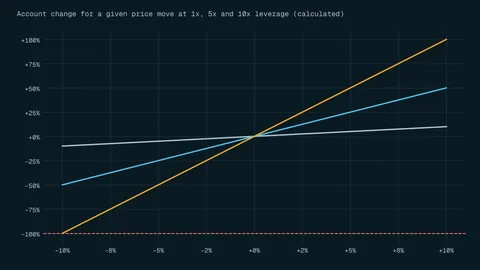
Profit and loss are calculated on the full position, not on the margin. So a price move of 1% changes the value of a $10,000 position by $100 whatever the leverage. The calculator shows that loss in dollars and as a share of the margin, and it shows the move at which the loss equals the whole margin.
loss = position size × move %
move that equals the margin = 100% / leverage
Can you check the result by hand?#
| Leverage | Margin required | Move that equals the margin | 2% move as share of margin |
|---|---|---|---|
| 2 : 1 | $5,000 | 50% | 4% |
| 5 : 1 | $2,000 | 20% | 10% |
| 10 : 1 | $1,000 | 10% | 20% |
| 20 : 1 | $500 | 5% | 40% |
| 30 : 1 | $333.33 | 3.33% | 60% |
| 50 : 1 | $200 | 2% | 100% |
The dollar loss from a 2% move is $200 in every row. Higher leverage only means that loss is a bigger share of the money you put up.
How do margin percentages and leverage relate?#
Regulators usually state a minimum margin as a percentage; leverage is the same rule written the other way round. Leverage = 100% / margin %, so 2% margin is 50:1 and 3.33% is about 30:1 (calculated).
In the US, a retail forex dealer must collect at least 2% of the notional value for major currency pairs and 5% for others [1]. The CFTC's example: a 2 percent margin requirement lets you open a $100,000 position with $2,000 [2]. In the UK, retail CFD providers must collect at least 3.33% of the exposure for major currency pairs, 5% for major indices, minor pairs and gold, 10% for minor indices and other commodities, and 20% for shares and other assets [3]. The more volatile the underlying asset, the higher the margin and so the lower the leverage allowed [3].
| Where and what | Minimum margin | Leverage equivalent |
|---|---|---|
| US retail forex, major pairs | 2% | 50 : 1 |
| US retail forex, other pairs | 5% | 20 : 1 |
| UK retail CFD, major currency pairs | 3.33% | 30 : 1 |
| UK retail CFD, shares | 20% | 5 : 1 |
Margins from US rules [1] and UK FCA rules [3]. Leverage figures are arithmetic equivalents (100% / margin), calculated. Rules differ in other countries, and a broker may ask for more than the minimum.
What does the calculator not account for?#
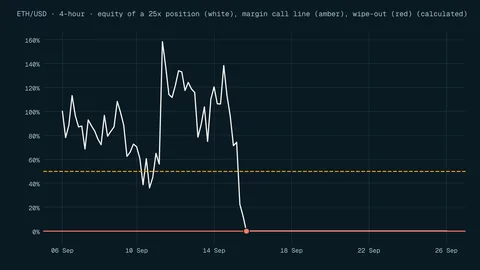
- Close-out before the margin is gone. UK retail CFD providers must close positions when your equity falls below 50% of the required margin [3]. At 30:1, if your account holds only the margin, that happens after a move of about 1.67%, half the 3.33% shown (calculated).
- Losses beyond your deposit. The CFTC warns that you may be liable for losses beyond your initial deposit [2]. UK rules limit a retail CFD client's losses to the funds in the account [3], but that protection depends on the product and the country.
- Costs. Spreads, commissions and overnight financing are charged on the full position, not the margin. Use the trading cost calculator for those.
- Gaps. Prices can jump past any level, so the move you plan for is not the largest move that can happen.
- Other money in your account. Extra funds give the position more room before a close-out, but they are at risk too.
What happens when the margin runs out?#
The broker asks for more money or closes your positions. US retail forex dealers must collect additional deposits or liquidate positions when deposits are too low [1]. Our guide to what happens after a margin call walks through the triggers market by market. Read it, and leverage and margin explained, before trading any leveraged product.
Frequently asked questions#
Does higher leverage mean a bigger loss?
Not for the same position. A 2% move on $10,000 costs $200 at any leverage. Higher leverage means less of your money is set aside, so the same loss is a bigger share of it, and it lets you open a much larger position with the same deposit.
What leverage can I use?
It depends on where you live and what you trade. US retail forex rules require at least 2% margin on major currency pairs and 5% on others [1]. UK retail CFD rules range from 3.33% on major currency pairs to 20% on shares [3]. Using less than the maximum is allowed and lowers the share of margin a move uses up.
Can I lose more than the margin?
Yes. The margin is only the collateral. The CFTC warns that you may be liable for losses beyond your initial deposit [2].
Why was my position closed before the loss reached the margin?
Many rules close positions early. UK retail CFD providers must close out when equity falls below 50% of the required margin [3]. Ask your broker for its close-out level.
The bottom line#
Use the calculator to see what a leveraged position really asks of you: how much margin it ties up, and how small a move can use all of it. The dollar loss comes from the full position size, and positions can be closed before the margin is gone. Read leverage and margin explained, the other risk management explainers and the risk disclosure before using leverage.
Sources
Education only. This page is not investment, tax or legal advice. Trading and crypto can lose you money. See our risk disclosure.