Glossary
Leverage: a bigger position than your deposit
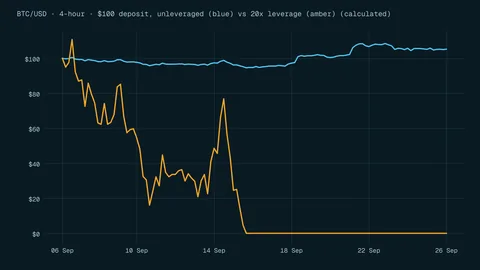
Leverage is the reason a small account can lose a lot of money quickly. It does not change the market; it changes how much of your own money each price move touches.
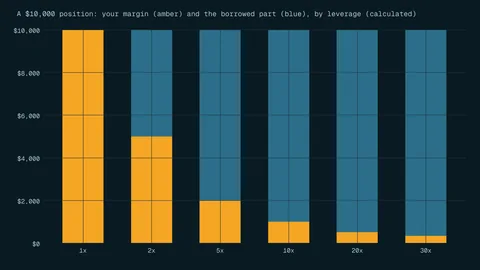
Leverage means controlling a position that is larger than the money you put down, using a margin deposit or borrowed money. It is usually written as a ratio, such as 50:1, and it magnifies losses exactly as much as gains.
Quick answer
Leverage lets you control a position bigger than your deposit. The CFTC's example: with a 2 percent margin requirement, $2,000 opens a $100,000 position [1]. That is 50:1 (calculated), so a 2% price move against you equals the whole deposit, and you may owe more.
Key points
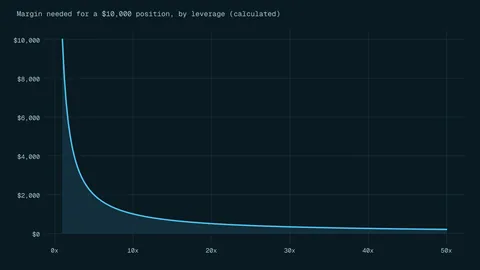
- Leverage ratio = position value / your deposit: $100,000 / $2,000 = 50:1 (calculated) [1].
- Regulators state plainly that leverage increases possible losses as well as possible profits [2].
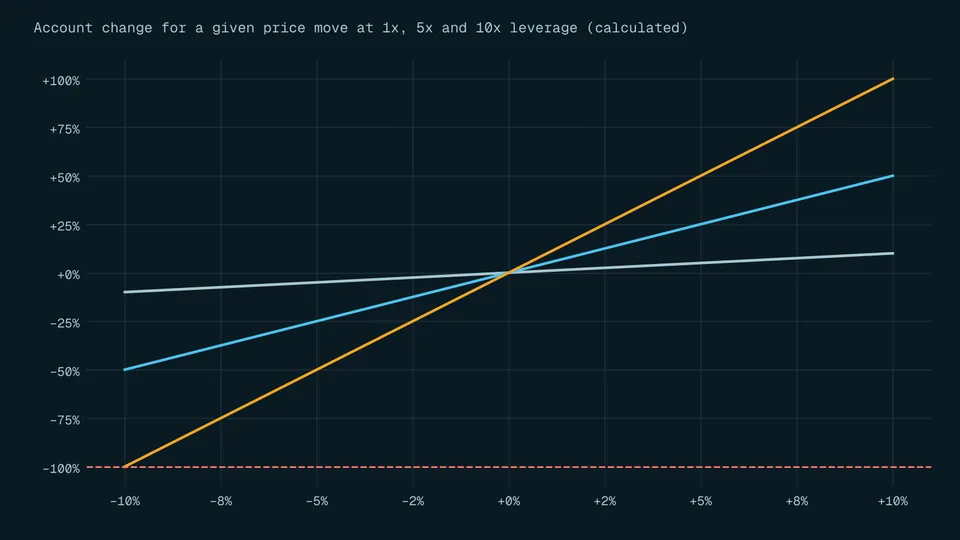
- The higher the leverage, the smaller the price move that wipes out your deposit: 2% at 50:1, 10% at 10:1 (calculated).
On this page
What does leverage mean in trading?#
When you trade with leverage, you put down a deposit called margin and the broker lets you hold a position many times that size. The CFTC gives the standard example: a 2 percent margin requirement means you could open a $100,000 forex position with only $2,000 in your account [1]. Divide the position by the deposit and you get the leverage ratio, here 50:1 (calculated).
The profit or loss is calculated on the full $100,000, not on your $2,000. That is the whole point of leverage, and the whole danger. The CFTC puts it in one line: this high degree of leverage amplifies both gains and losses [1].
leverage ratio = position value / your deposit (margin)
How does leverage change the size of a loss?#
Keep the deposit and the price move the same and change only the leverage. The table shows a $1,000 deposit and a 2% price move against you. Without leverage you lose $20. At 50:1 you lose the whole $1,000. The last column shows how small a move is enough to wipe out the deposit.
| Leverage | Position value | Loss | Share of deposit lost | Move that wipes out the deposit |
|---|---|---|---|---|
| 1:1 | $1,000 | $20 | 2% | 100% |
| 10:1 | $10,000 | $200 | 20% | 10% |
| 30:1 | $30,000 | $600 | 60% | 3.33% |
| 50:1 | $50,000 | $1,000 | 100% | 2% |
$1,000 deposit, price moves 2% against you. All figures calculated. Costs such as spreads and financing would make each loss larger.
The same arithmetic works in your favour when the price moves the other way, and that upside is the part people notice first. Regulators look at both sides. ESMA's 2018 decision on contracts for difference (CFDs) notes that leverage can increase possible profits but also possible losses, and that high leverage can lead to large losses for retail clients over a very short time span [2].
How much leverage do regulators allow?#
It depends on where you live and what you trade. In the US, retail forex dealers must collect at least 2% of the position value for major currency pairs and 5% for other pairs [3], which works out to 50:1 and 20:1 (calculated). In the UK, the FCA sets a minimum margin for retail CFDs by type of asset, with more margin, and so less leverage, for more volatile assets [4]. The table below shows the UK minimum margin for each type of asset and the leverage it implies.
| Underlying asset | Minimum margin | Maximum leverage |
|---|---|---|
| Major currency pair | 3.33% | 30:1 |
| Major stock index, minor currency pair or gold | 5% | 20:1 |
| Minor stock index or other commodity | 10% | 10:1 |
| Individual share or other asset | 20% | 5:1 |
Margin percentages from FCA PS19/18 (COBS 22.5) [4]. Leverage column is 100 / margin, calculated.
Notice the pattern: the more volatile the asset, the lower the leverage allowed. Crypto shows why this matters: the CFTC describes virtual currencies as more volatile than traditional currencies and says that profits and losses from that volatility are amplified in margined contracts [5]. If a platform outside these rules offers higher leverage, that only makes the move that wipes you out smaller.
To see what a position needs in margin before you open it, use our margin calculator. For the full picture of how margin calls and forced closing work, read leverage and margin explained.
Frequently asked questions#
Is higher leverage more dangerous?
Yes, for the same deposit. At 50:1 a 2% move against you equals your whole deposit; at 10:1 it takes a 10% move (calculated). The broker may also close your position before that point, an event called liquidation.
Can I lose more than my deposit with leverage?
Do I have to use all the leverage my broker offers?
No. The leverage on offer is a maximum. You choose your position size, and you can size each trade so that a stopped-out loss is small. Our guide to position sizing shows how.
The bottom line#
Leverage is a multiplier on your own money, in both directions. Before any leveraged trade, work out the full position value, the move that would cost your whole deposit, and whether you could afford that loss. Read the risk disclosure before trading any leveraged product.
Sources
- Customer Advisory: Eight Things You Should Know Before Trading Forex.
- European Securities and Markets Authority Decision (EU) 2018/796 of 22 May 2018 to temporarily restrict contracts for differences in the Union in accordance with Article 40 of Regulation (EU) No 600/2014.
- 17 CFR 5.9 -- Security deposits for retail forex transactions..
- PS19/18: Restricting contract for difference products sold to retail clients.
- Customer Advisory: Understand the Risks of Virtual Currency Trading.
Education only. This page is not investment, tax or legal advice. Trading and crypto can lose you money. See our risk disclosure.