Glossary
Liquidation: when your broker closes the trade
Liquidation is not a decision you make. It is what happens to a leveraged position when losses eat into your deposit far enough that the broker steps in to protect its own money.
Liquidation is the forced closing of your position by a broker, exchange or lending protocol because your margin or collateral has fallen below the level it requires. It turns a paper loss into a real one, at whatever price is available.
Quick answer
Liquidation is when a broker or exchange closes your position for you because your margin has fallen too low. US forex dealers must either collect more money or liquidate [1]. The loss becomes final, and with some products you may still owe more than you deposited.
Key points
- Liquidation is triggered by your equity falling below a required level, not by your stop or your choice [1].
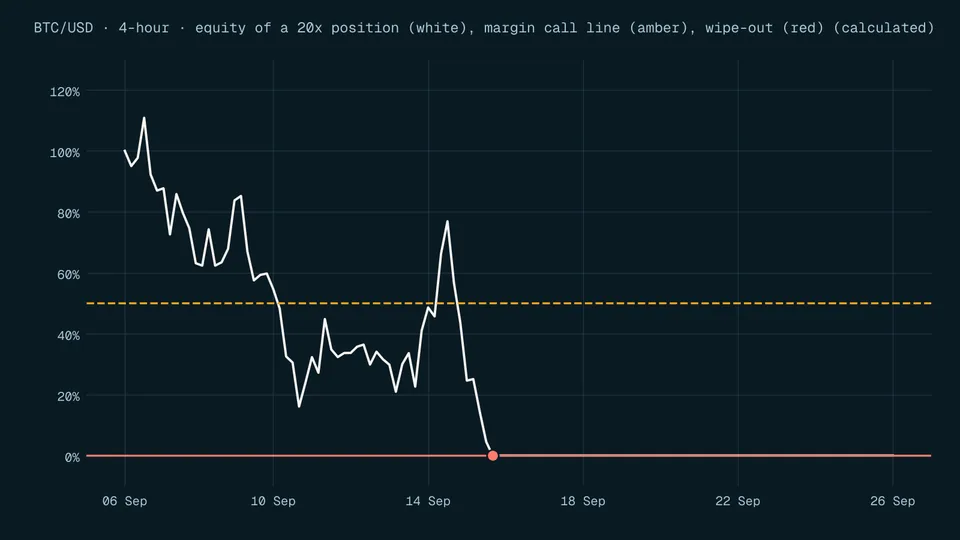
- UK retail CFD providers must close out when equity falls below 50% of the required margin [4].
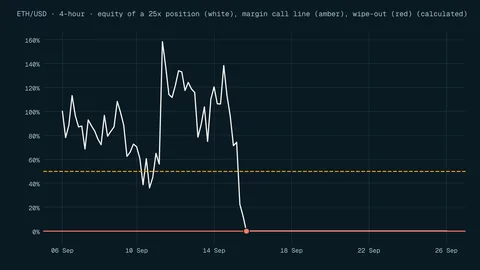
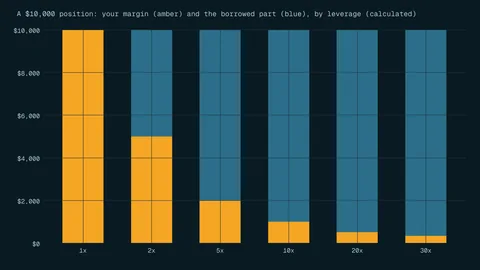
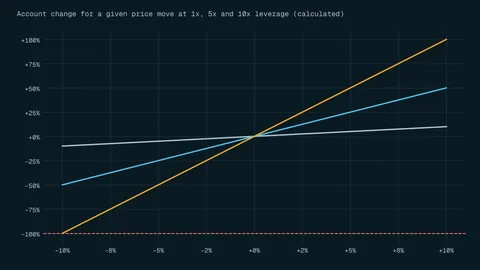
- The bigger your position compared with your account, the smaller the price move that triggers liquidation (calculated).
On this page
What does liquidation mean in trading?#
When you trade with leverage, your deposit, called margin, is security for the broker. If losses shrink that deposit below the level the broker requires, the broker can close your positions to stop the losses from reaching its own money. That forced closing is liquidation.
The rules say this plainly. A US retail forex dealer whose customer's deposits fall short must either collect more money or liquidate the customer's positions [1]. For stock margin accounts, FINRA says firms do not have to issue a margin call before selling, and do not have to let you choose what is sold [2]. The CFTC warns crypto futures traders that after adverse moves they may be forced to refill their margin or close out their positions [3].
When does a broker liquidate your position?#
Each broker sets its trigger within the rules where it operates. In the UK, retail CFD providers must close out positions so that a client's net equity does not fall below 50% of the margin required to keep them open [4]. Before Europe's 2018 rules, ESMA found some CFD providers set this close-out point anywhere between 0 and 30% of initial margin [5].
The table uses the UK rule. You have a $1,500 account and trade a CFD on a major stock index, where the UK minimum margin is 5% [4]. The only thing that changes is how large a position you open.
| Position size | Margin required | Close-out when equity falls below | Loss that triggers it | Price move that triggers it |
|---|---|---|---|---|
| $5,000 | $250 | $125 | $1,375 | 27.5% |
| $10,000 | $500 | $250 | $1,250 | 12.5% |
| $20,000 | $1,000 | $500 | $1,000 | 5% |
| $30,000 | $1,500 | $750 | $750 | 2.5% |
$1,500 account, 5% margin, close-out at 50% of required margin [4]. All amounts calculated; spreads and financing would trigger close-out slightly sooner.
What happens after you are liquidated?#
The loss becomes final, and the position is gone, so a later recovery in price does not help you. In some products the damage can go further than your deposit. The CFTC warns forex customers that they may be liable for losses beyond their initial deposit [6], and the NFA says futures customers must make up any deficits that exceed their margin deposits [7]. In the UK, negative balance protection limits a retail CFD client's liability to the funds in the account [4].
Crypto lending works on the same idea. On the Aave protocol, a borrowing position becomes eligible for liquidation when its health factor falls below 1, and outside liquidators repay part of the debt in exchange for the borrower's collateral [8]. Our sources do not describe how individual crypto exchanges calculate liquidation prices for leveraged futures, so read the exchange's own rules before using leverage there.
The practical defence is the table above: keep positions small enough that ordinary price moves stay far from your close-out level. Our guide to margin calls and liquidation goes through the process step by step, and the margin calculator shows what a position needs before you open it.
Frequently asked questions#
Can I stop a broker from liquidating my position?
Only by keeping enough equity in the account, either by adding money in time or by using smaller positions. FINRA says firms can sell without a margin call and you may not choose what is sold [2].
Is liquidation the same as a stop-loss?
No. A stop-loss is an order you choose to place at a price you pick. Liquidation is forced by the broker when your equity falls below its requirement, usually after a much larger loss.
The bottom line#
Liquidation is the broker protecting itself from your losses, at a price you do not choose. Size positions so that your close-out level sits far from normal price swings, and never trade with money you cannot afford to lose. Read the risk disclosure before using leverage.
Sources
- 17 CFR 5.9 -- Security deposits for retail forex transactions..
- Know What Triggers a Margin Call.
- Customer Advisory: Understand the Risks of Virtual Currency Trading.
- PS19/18: Restricting contract for difference products sold to retail clients.
- European Securities and Markets Authority Decision (EU) 2018/796 of 22 May 2018 to temporarily restrict contracts for differences in the Union in accordance with Article 40 of Regulation (EU) No 600/2014.
- Customer Advisory: Eight Things You Should Know Before Trading Forex.
- Investor Best Practices | NFA.
- Aave V3 Overview | Aave Protocol Documentation.
Education only. This page is not investment, tax or legal advice. Trading and crypto can lose you money. See our risk disclosure.