Explainer · Risk Management
Margin calls and liquidation: what happens and when
When you trade with borrowed money, the lender can close your positions if your own money in the account runs too low. This page explains when that happens, who decides, and why it can leave you owing money.
Quick answer
A margin call happens when the equity in a margin account falls below the required minimum, at least 25% of the securities' value under FINRA rules [1]. You must add money or the broker sells positions, and it may sell without warning [2]. Liquidation is that forced sale.
Key points
- Margin is a loan secured by what is in your account; your equity is the value minus the loan [1].
- Under FINRA rules, equity in a US margin account must stay at 25% or more of market value, and many firms set 30% to 40% [2].
- A broker can sell your positions without a margin call, and you do not get to choose which [1].
- Account value that triggers a call = loan / (1 - maintenance requirement). Work it out before you buy.
- Some products let you lose more than you deposited; UK retail CFD accounts have negative balance protection [4].
On this page
What is a margin call?#
When you buy on margin, your broker lends you cash and uses the assets in your account as collateral [1]. What you own outright is your equity: the market value of the account minus the loan. Prices move, but the loan does not, so every fall in price comes straight out of your equity.
Brokers require your equity to stay above a minimum, called the maintenance requirement. Under FINRA rules it must be at least 25 percent of the total market value of the margin securities, and many firms set higher "house" requirements, typically between 30 and 40 percent [2]. If your equity falls below that line, the broker can demand more money (a margin call) or sell your positions to repay the loan (liquidation).
How does a price fall trigger a margin call?#
The SEC gives a worked example. You buy $16,000 of securities, paying $8,000 in cash and borrowing $8,000 from your firm. The value falls to $12,000, so your equity is $4,000. At a 25% maintenance requirement you need $3,000 of equity, so there is no call. At a 40% house requirement you need $4,800, so you face a margin call [2]. The shortfall in that case is $800 (calculated).
You can work out the trigger before you buy. A call comes when equity (value minus loan) falls below the maintenance share of the value. Rearranged, that gives one formula.
account value that triggers a call = loan / (1 - maintenance requirement)
| Maintenance requirement | Account value at the trigger | Fall from purchase |
|---|---|---|
| 25% | $10,666.67 | 33.3% |
| 30% | $11,428.57 | 28.6% |
| 35% | $12,307.69 | 23.1% |
| 40% | $13,333.33 | 16.7% |
25% is the FINRA minimum and 30% to 40% is the typical house range [2]. Firms can raise their requirement at any time without advance notice [2], which moves the trigger closer.
Notice how much the house rule matters. With the same position, a 40% requirement is reached after a fall of 16.7%, half the 33.3% fall needed at the legal minimum (calculated). FINRA's page also refers to new intraday margin requirements, under which equity must be adequate throughout the day, not just at the close of trading [1]. Ask your broker how they apply to your account.
What happens if you cannot meet a margin call?#
The broker sells. The SEC lists rights many investors assume they have but do not. Your firm can sell your securities at any time without consulting you first. You are not entitled to choose which securities it sells, and you are not entitled to an extension of time on a margin call [2]. FINRA adds that firms do not have to issue a margin call before selling at all [1].
A forced sale turns a paper loss into a real one at whatever price the market offers at that moment. If prices then recover, you no longer own the position.
How do forex and CFD close-outs work?#
Leveraged forex and CFD accounts work on the same idea, but the margin is much thinner, so far smaller price moves matter. In the US, a retail forex dealer must hold a security deposit of at least 2% of the notional value for major currency pairs and 5% for others. If the deposit is not enough, the dealer must collect more or liquidate your positions [3]. The CFTC's own example: a 2 percent margin requirement means you could open a $100,000 position with only $2,000, and an adverse move means you must add money or close the position [7].
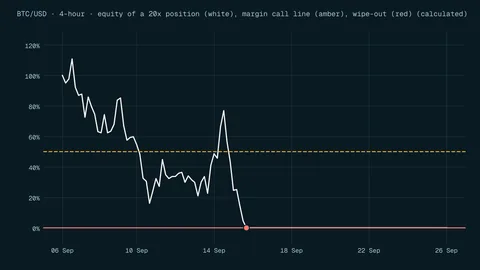
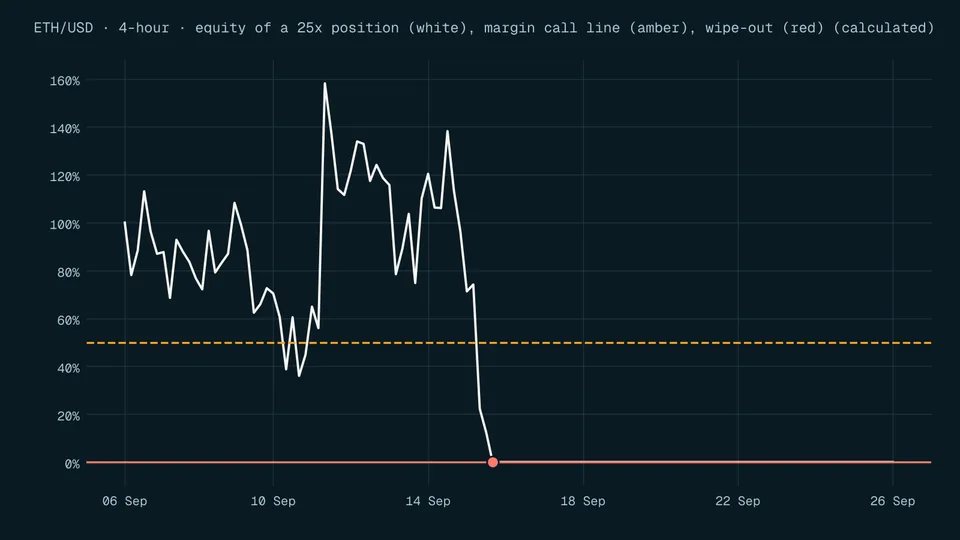
In the UK, retail CFD providers must close out positions when your net equity falls below 50% of the margin needed to keep them open, and a retail client's losses are limited to the funds in the CFD account (negative balance protection) [4]. In its 2018 decision on CFDs, ESMA noted that some providers had previously set their close-out level anywhere between 0 and 30% of initial margin [8].
| Market | Trigger | What happens |
|---|---|---|
| US stocks on margin | Equity below 25% of market value, or the higher house level | Margin call or sale, possibly without notice |
| US retail forex | Deposit below 2% (major pairs) or 5% (other pairs) of notional | Dealer collects more money or liquidates |
| UK retail CFDs | Equity below 50% of required margin | Positions closed; losses limited to account funds |
| Aave crypto lending | Health factor below 1 | Liquidators repay part of the debt and take collateral |
| Crypto exchange futures | Set by each exchange | Not covered by our primary sources |
Sources: US stocks [2] [1], US forex [3], UK CFDs [4], Aave [5]. Rules in other countries differ.
What does liquidation mean in crypto?#
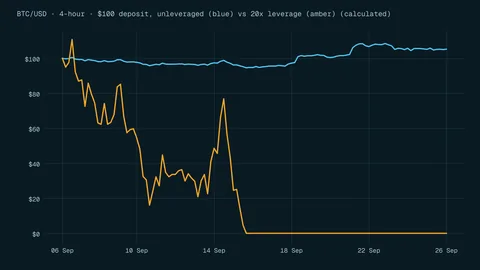
The CFTC describes virtual currencies as more volatile than traditional currencies and warns that leverage amplifies those price swings. If the market moves against you, you may be forced to refill your margin account or close out your positions, and you may lose more than your initial investment [9].
In decentralised lending, the rules are written into the protocol. On Aave V3, each borrower has a health factor; when it falls below 1, the position becomes eligible for liquidation, and outside liquidators can repay part of the debt in exchange for your collateral [5]. No one phones you first. The code allows it once the number crosses the line.
How can you make a margin call less likely?#
The surest way is to borrow less. Keep the $8,000 of your own money from the SEC example, but borrow $4,000 instead of $8,000. The position is $12,000, and at a 25% requirement a call needs a fall of 55.6% rather than 33.3%. Borrow $2,000 and the fall needed is 73.3% (all calculated). Leverage that looks small on paper still changes how much room you have. Our page on leverage and margin explained covers why.
- Find the real requirement
Ask your broker for its house maintenance level, not just the legal minimum, and how it can change.
- Calculate the trigger before you buy
Loan / (1 - requirement) gives the account value at which a call comes. Compare it with today's value.
- Borrow less than the maximum
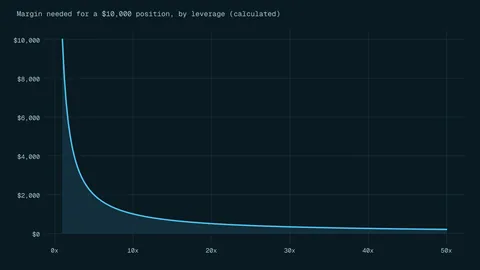
Every dollar you do not borrow moves the trigger further away. Our margin calculator shows how much margin a position ties up.
- Size from the loss you can accept
Use position sizing so that a stopped-out trade costs a small, planned share of the account.
- Decide your response in advance
Write down whether you would add money or close. Topping up a losing position puts more money at risk.
| Amount borrowed | Position size | Fall that triggers a call |
|---|---|---|
| $8,000 | $16,000 | 33.3% |
| $4,000 | $12,000 | 55.6% |
| $2,000 | $10,000 | 73.3% |
At a 40% house requirement the same loans trigger a call after falls of 16.7%, 44.4% and 66.7% (calculated).
Mistakes beginners make with margin calls#
- Expecting a phone call first
Firms do not have to issue a margin call before selling [1]. The first sign may be a position that is already gone.
- Using the legal minimum in your maths
House requirements of 30% to 40% are common and can rise without notice [2]. Plan with the broker's number.
- Borrowing the full amount available
Maximum borrowing puts the trigger as close as it can be. A modest fall then forces a sale.
- Meeting call after call
Each top-up keeps a losing position open with more of your money in it. Decide your limit before the first call, not during it.
Frequently asked questions#
Can my broker sell my shares without a margin call?
Yes. FINRA says firms do not have to issue a margin call before selling securities in your margin account, and they do not have to let you choose what is sold [1].
How long do I have to meet a margin call?
There is no guaranteed period. The SEC says you are not entitled to an extension of time on a margin call [2], and your firm can sell at any time. Ask your broker how it handles calls before you borrow.
Can I lose more than I deposited?
Is liquidation the same as a margin call?
No. A margin call is a demand for more money. Liquidation is the forced sale or close-out of your positions, which can happen after an unmet call or, at many firms, with no call at all.
The bottom line#
A margin call is the moment the loan behind a trade catches up with you. Know your broker's real maintenance level, calculate the account value that triggers a call before you buy, borrow less than the maximum, and decide in advance what you will do. Forced sales happen at the market's price, not yours, and in some products the loss can exceed your deposit. Try the numbers in our margin calculator and read the risk disclosure before trading with borrowed money.
Sources
- Know What Triggers a Margin Call.
- Investor Bulletin: Understanding Margin Accounts.
- 17 CFR 5.9 -- Security deposits for retail forex transactions..
- PS19/18: Restricting contract for difference products sold to retail clients.
- Aave V3 Overview | Aave Protocol Documentation.
- Investor Best Practices | NFA.
- Customer Advisory: Eight Things You Should Know Before Trading Forex.
- European Securities and Markets Authority Decision (EU) 2018/796 of 22 May 2018 to temporarily restrict contracts for differences in the Union in accordance with Article 40 of Regulation (EU) No 600/2014.
- Customer Advisory: Understand the Risks of Virtual Currency Trading.
Education only. This page is not investment, tax or legal advice. Trading and crypto can lose you money. See our risk disclosure.