Glossary
Stop-loss meaning: an exit order, not a guarantee
A stop-loss is the most common way beginners try to cap a loss. It helps, but it is an instruction to exit, not a promise about the exit price.
A stop-loss is an order to sell (or buy back) a position once the price reaches a level you choose, called the stop price. When that price is reached it becomes a market order, so the price you actually get can be worse than the stop.
Quick answer
A stop-loss is an order to buy or sell once the price reaches a level you set; the SEC treats stop order and stop-loss order as the same thing [1]. When triggered it becomes a market order, and FINRA notes stop prices are not guaranteed execution prices [2].
Key points
On this page
What does stop-loss mean?#
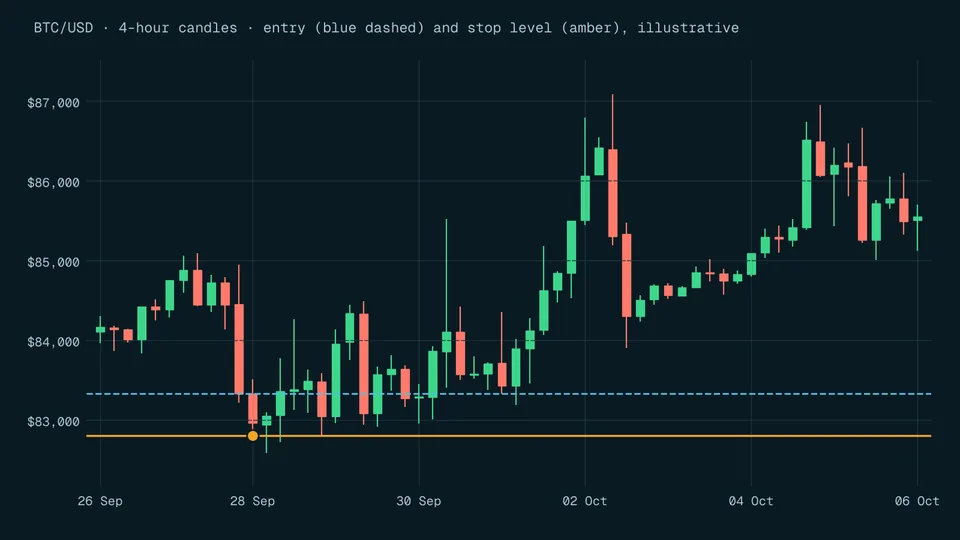
A stop-loss is an exit you set in advance. The SEC defines a stop order, also called a stop-loss order, as an order to buy or sell once the price reaches a specified price, known as the stop price [1]. If you own something, a sell stop below the current price is meant to get you out if the price falls. If you have sold short, a buy stop above the price does the same job in reverse.
The key detail is what happens at the trigger. When the stop price is reached, a stop order becomes a market order [1], which fills at the next available price. FINRA's example: with a sell stop at $50, the order becomes a market order when the stock hits $50, and in a fast market you could receive significantly less than $50 per share [2]. That gap between the stop and the fill is a form of slippage.
Does a stop-loss limit your loss exactly?#
No. FINRA says it directly: stop prices are not guaranteed execution prices [2]. Your planned loss is the distance from your entry to your stop. Your real loss is the distance from your entry to the fill. The table shows how far apart those can be.
| Fill price | Loss | Loss as share of position |
|---|---|---|
| $55 (at the stop) | $250 | 8.33% |
| $54 | $300 | 10% |
| $52 | $400 | 13.33% |
| $50 | $500 | 16.67% |
50 shares bought at $60, sell stop at $55. All figures calculated, before costs.
What are the main types of stop order?#
| Order type | What happens at the stop price | Main risk |
|---|---|---|
| Stop (stop-loss) | Becomes a market order | Fill can be well below the stop |
| Stop-limit | Becomes a limit order at your limit price | May never fill if the price moves past the limit |
| Trailing stop | Stop price follows the market by a set amount or percentage | Same fill risk as a stop once triggered |
Order types as described by the SEC [1].
A stop-limit order combines a stop with a limit order, and the SEC warns it may not be executed at all if the price moves away from your limit [1]. A trailing stop sets the stop a fixed dollar amount or percentage away from the market price. In the SEC's example, you buy at $20, the stock rises to $22 and you place a $1 trailing stop; the stock peaks at $24 and falls, and the shares are sold when it reaches $23 [1].
Two more cautions. A short-lived intraday move can trigger your stop and fill you at a poor price [1]. And a stop is a risk control, not a source of profit: a study of stop-loss rules found that if prices move randomly, stopping out always lowers expected return, while some stop rules did better when prices were not random [3]. The full guide to stop-loss orders covers placement and these limits in more detail.
Frequently asked questions#
Does a stop-loss guarantee my maximum loss?
No. A triggered stop becomes a market order, and FINRA says stop prices are not guaranteed execution prices [2]. In fast markets the fill can be significantly worse.
Is a stop-loss the same as a stop order?
Yes. The SEC uses the two names for the same order: one to buy or sell once the price reaches a specified price [1].
Where should I put my stop-loss?
The regulator guidance we cite gives no placement rule. A common approach is to place it where your reason for the trade would be proven wrong, then size the position so that the loss at that stop is an amount you can afford. Our position size calculator does that sum.
The bottom line#
A stop-loss is a plan to exit, written down before emotions arrive. Use it, but size every trade as if the fill could be worse than the stop, because sometimes it will be. Read the risk disclosure before trading.
Sources
Education only. This page is not investment, tax or legal advice. Trading and crypto can lose you money. See our risk disclosure.