Glossary
Margin: the deposit behind a leveraged trade
Margin lets you trade with more than you have, and the broker holds your deposit as security for that. When prices fall, the broker protects its loan first, not your position.
Margin is the money you put up as collateral when a broker lends you the rest of a position, either as a loan to buy securities or as a deposit on a leveraged product such as forex or CFDs. If the position loses value, the broker can demand more money or close it.
Quick answer
Margin is the collateral you deposit so a broker lends you the rest of a trade. FINRA describes it as the firm lending you cash with your account's assets as collateral [1]. If losses push your equity below the required level, the firm can sell your positions, sometimes without warning.
Key points
- Your equity is what the account is worth minus what you borrowed; losses come out of your equity first.
- In the US, FINRA's minimum maintenance level is 25% of market value, and many firms set 30% to 40% [2].
- A firm does not have to issue a margin call before selling your securities, and you may not choose what is sold [1].
On this page
What does margin mean in trading?#
The word is used in two closely related ways.
In a stock margin account, margin is borrowing. FINRA explains that when you buy stock on margin, your brokerage firm lends you cash, using the assets in your account as collateral [1]. Under the Federal Reserve's Regulation T you may borrow up to 50 percent of the purchase price [2].
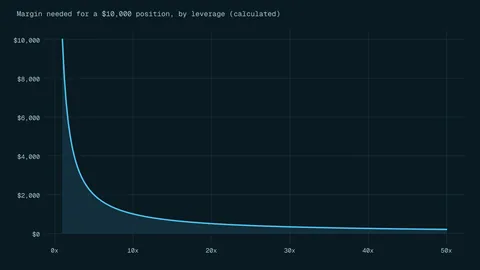
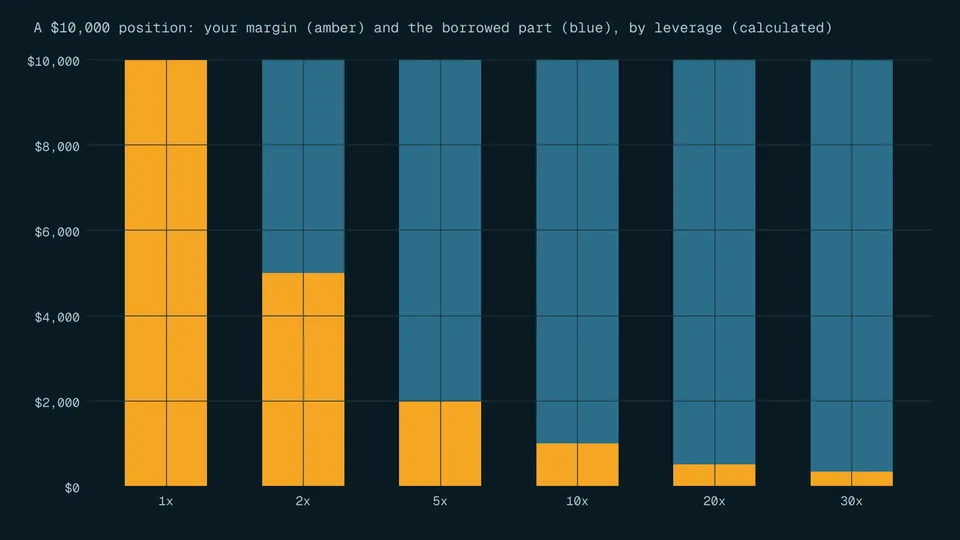
In forex, CFDs and futures, margin is the deposit that lets you open a position much larger than the deposit itself, which is leverage. The CFTC's example: a 2 percent margin requirement means $2,000 can open a $100,000 position [3]. In both cases the deposit is security for the broker, and every loss on the full position is taken from it.
equity = market value of the position - money borrowed
How does a margin call happen?#
Firms set a maintenance requirement: the smallest equity you must keep as a share of the account's market value. FINRA's minimum is 25 percent, and many firms set a higher house level, typically 30 to 40 percent [2]. If your equity falls below that level, the firm can ask you to add money (a margin call) or sell your holdings.
The SEC walks through an example: you buy $16,000 of securities with $8,000 of your own cash and $8,000 borrowed, and the value then falls to $12,000 [2]. The table follows that account as the price drops.
| Market value | Your equity | Equity as share of value | Margin call at 25%? | Margin call at 40%? |
|---|---|---|---|---|
| $16,000 | $8,000 | 50% | No | No |
| $14,000 | $6,000 | 42.86% | No | No |
| $12,000 | $4,000 | 33.33% | No | Yes, short $800 |
| $10,000 | $2,000 | 20% | Yes, short $500 | Yes, short $2,000 |
Loan stays at $8,000. The $16,000 and $12,000 rows follow the SEC example [2]; the other rows and every shortfall are calculated.
- At a 25% maintenance level
- below $10,666.67a 33.33% fall from $16,000, calculated
- At a 40% house level
- below $13,333.33a 16.67% fall from $16,000, calculated
- Loss on your own $8,000 at that point (40% level)
- $2,666.6733.33% of your cash, calculated
Can you lose more than your margin?#
Yes. In the SEC's loss example, a $50 stock bought with half borrowed money falls to $15, and the margin buyer loses more than 100 percent of their own money and still owes the broker $10 [2]. The CFTC warns forex customers that they may be liable for losses beyond their initial deposit [3].
Some rules limit this for retail clients. In the UK, negative balance protection limits a retail CFD client's liability to the funds in the account [4]. US securities margin and US retail forex work differently, so check which rules apply to your account before you trade.
Before opening a position, check how much margin it needs and how far the price can move before your equity hits the maintenance level. Our margin calculator does the first part, and margin calls and liquidation explains what the broker can do next.
Frequently asked questions#
What is the difference between initial and maintenance margin?
Is margin a fee?
No. Margin is your own money held as collateral, not a charge. Costs come on top: an undated CFTC advisory says most US OTC forex customers lose money once all credits, financing charges, fees and other expenses are factored in [3]. Ask your broker what borrowing or holding a position overnight costs.
The bottom line#
Margin is collateral, and the broker's priority is protecting its loan. Know your equity, the maintenance level that applies, and the fall that would trigger a call, before you trade. Use only money you can afford to lose, and read the risk disclosure first.
Sources
Education only. This page is not investment, tax or legal advice. Trading and crypto can lose you money. See our risk disclosure.