Explainer · Crypto Basics
What is Bitcoin? A plain-English explanation
Bitcoin is a digital asset that moves between people over a shared network instead of through a bank. This page explains how it works, where new coins come from and why regulators call it highly speculative.
Quick answer
Bitcoin is a crypto asset: a digital token recorded on a public blockchain and sent between users without a bank in the middle [1]. It is not legal tender [3], prices swing sharply, and US regulators call it a highly speculative investment [2].
Key points
- Bitcoin was designed so payments go from one person to another without a financial institution [1].
- Payments are grouped into blocks, and each block is linked to the one before it, which makes past records hard to change [5].
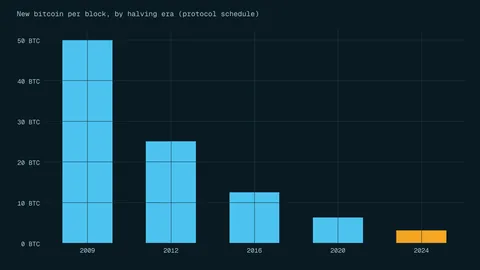
- New coins are created as a reward in each block; that reward started at 50 coins and halves every 210,000 blocks [6].
- One bitcoin is 100,000,000 satoshis, so you never have to buy a whole coin [7].
- Regulators warn that you can lose all the money you put in, and that most crypto platforms lack bank-style protection [8] [10].
On this page
What is Bitcoin, in one paragraph?#
Bitcoin is a digital asset and the network that keeps track of who owns it. It was described in a short paper titled "Bitcoin: A Peer-to-Peer Electronic Cash System", written under the name Satoshi Nakamoto [1]. The paper's goal was a way to send online payments directly from one party to another without going through a financial institution [1].
The hard part of digital money is stopping someone from spending the same coin twice. Card and bank payments rely on a financial institution in the middle to keep the record. Bitcoin's answer is a ledger that many computers on a peer-to-peer network hold a copy of, with rules that make rewriting history extremely expensive [1]. That shared ledger is a blockchain; our explainer on what is a blockchain covers the mechanics in more detail.
How does a Bitcoin payment get recorded?#
There is no central server that says "payment approved". Instead, the whitepaper describes a routine that every participating computer (a node) follows [1]. A new payment is broadcast to the network, nodes collect waiting payments into a block, and a miner tries to solve a costly computing puzzle called proof-of-work. When one succeeds, other nodes check the block and accept it only if every payment in it is valid and not already spent [1].
Each new block includes a fingerprint (a hash) of the block before it, so the blocks form a chain [1]. The network treats the longest chain, the one with the most work behind it, as the true record [1]. Every extra block stacked on top of your payment makes it harder for an attacker to rewrite it; the paper says the attacker's chance of catching up drops exponentially with each block [1].
The software aims for one new block every 10 minutes on average [4]. If blocks arrive too fast, the puzzle gets harder [1]; NIST describes this adjustment happening every 2016 blocks [5]. At the target pace that is 144 blocks a day and a difficulty check about every 14 days (calculated).
Where do new bitcoins come from?#
There is no central bank issuing bitcoin. The first transaction in each block creates new coins for whoever produced that block, and the whitepaper describes this as the way coins enter circulation when no central authority exists to issue them [1]. The paper says this reward gives nodes an incentive to support the network [1].
The reward is not fixed forever. In the Bitcoin Core software it starts at 50 coins per block and is cut in half every 210,000 blocks, which the code comment says happens approximately every 4 years [6]. That event is the bitcoin halving. The software also caps any valid amount at 21,000,000 coins, and the code itself notes that the actual supply is less than that [7].
- First block reward
- 50 BTCBitcoin Core source [6]
- Reward halves every
- 210,000 blocksmainnet parameter [4]
- Target time between blocks
- 10 minutesa target, not a guarantee [4]
- Maximum valid amount
- 21,000,000 BTCa sanity cap; actual supply is lower [7]
- Smallest unit (1 satoshi)
- 0.00000001 BTC100,000,000 satoshis per coin [7], calculated
Do you have to buy a whole bitcoin?#
No. In the Bitcoin Core code one coin equals 100,000,000 of the smallest unit, usually called a satoshi or sat [7]. Platforms let you buy fractions, so the price of one whole coin says little about how much you need to start. The table converts a few amounts so the decimals stop being intimidating.
| Amount in BTC | Satoshis | Share of one coin |
|---|---|---|
| 1 | 100,000,000 | 100% |
| 0.01 | 1,000,000 | 1% |
| 0.001 | 100,000 | 0.1% |
| 0.00025 | 25,000 | 0.025% |
| 0.00000001 | 1 | 0.000001% |
Conversions calculated from 1 BTC = 100,000,000 satoshis [7].
Small amounts are a sensible way to learn how a wallet, a transfer and a fee work. They do not reduce the percentage risk: a fraction of a coin rises and falls by the same percentage as a whole one.
What are the risks of owning Bitcoin?#
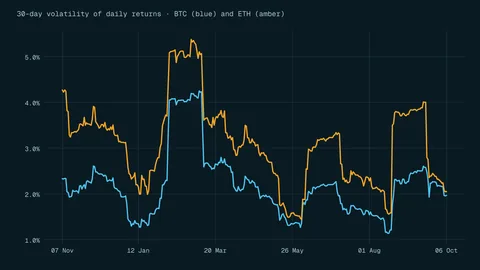
Regulators on both sides of the Atlantic say the same thing in different words. The SEC calls bitcoin and ether highly speculative investments and tells investors to consider the volatility of their prices [2]. The CFTC says virtual currency value comes entirely from supply and demand and is more volatile than traditional currencies, and that most cash markets for it are not regulated or supervised by a government agency [3]. The UK FCA says you should be prepared to lose all your money [8]. Our page on why is crypto so volatile looks at the causes.
Research on real investors points the same way. A BIS study of crypto app use in 95 countries from 2015 to 2022 estimated that 73% to 81% of retail investors likely lost money on their initial bitcoin investment [9].
| Risk | What it means in practice |
|---|---|
| Price swings | The value can fall sharply and quickly, including sudden flash crashes. |
| No deposit protection | Accounts at crypto firms do not get the SIPC or FDIC protection that bank or broker accounts generally get. |
| Platform failure | Exchanges and wallet providers have suffered hacks and severe operational problems. |
| Irreversible payments | A crypto payment typically cannot be reversed, unlike a card payment. |
| Scams | Fraudsters use crypto's popularity to lure people into schemes. |
Sources: CFTC [3], SEC [10], EU supervisors [11], FTC [12].
What should you check before you put money into Bitcoin?#
None of this is a reason to buy or a reason not to. It is a checklist of questions regulators ask people to answer first. The EU supervisors' first question is simple: can you afford to lose all the money you invest [11]?
- Set an amount you can lose in full
Pick a sum that would not change your rent, bills or savings if it went to zero. The FCA says to be prepared for exactly that [8].
- Decide who holds the keys
On a platform, a company holds them for you; in your own wallet, you do. Each carries different risks [13]. Our guide to custodial vs non custodial wallet set-ups compares them.
- Check the firm, not the advert
Look up the platform with your national regulator and read how it holds customer assets. Our checklist on is a crypto exchange safe walks through it.
- Learn the scam patterns first
The FTC says only scammers demand payment in crypto or guarantee profits [12]. Anyone who contacts you out of the blue about bitcoin is a red flag.
- Test with a small transfer
Send a tiny amount first and confirm it arrived before moving more, because sent coins typically cannot be pulled back [12].
Mistakes beginners make with Bitcoin#
- Buying because the price just jumped
The BIS found that rising bitcoin prices pull more people into crypto apps [9], so many newcomers arrive after a move has already happened.
- Treating the 21 million cap as a price promise
A limited supply says nothing about demand. Value comes from what buyers will pay [3], and that can fall.
- Assuming a platform account is insured
The SEC says accounts with crypto firms lack SIPC and FDIC-style protection [10]. If the firm fails, you may not get your coins back.
- Sharing a seed phrase or private key
No genuine support team needs it. The SEC says never share your private keys or seed phrases [13].
- Putting in money you need
Rent, emergency savings and debt repayments do not belong in an asset that regulators say you should be prepared to lose entirely [8].
Frequently asked questions#
Who created Bitcoin?
The whitepaper is signed Satoshi Nakamoto [1]. Who that is has never been established by the sources we use, so treat any claim about the person with caution.
When did Bitcoin start?
The first block in the Bitcoin Core code embeds a newspaper headline dated 3 January 2009 [4], and its timestamp converts to 3 January 2009, 18:15 UTC (calculated).
Is Bitcoin's supply exactly 21 million?
No. 21,000,000 is the largest amount the software treats as valid. The code comment says it is a sanity check, not the total supply, which is less than 21,000,000 BTC [7].
Can a Bitcoin payment be reversed?
Generally no. The FTC notes that crypto payments typically are not reversible, while card payments have legal protections if something goes wrong [12]. Double-check every address before sending.
Is Bitcoin regulated?
It depends on where you live and what you do with it. In the US, the CFTC says bitcoin has been determined to be a commodity, but most cash markets are not regulated or supervised by a government agency [3]. See crypto regulation for more.
The bottom line#
Bitcoin is a shared ledger plus a set of rules: payments are grouped into blocks, blocks are chained together with proof-of-work, and new coins arrive on a schedule that halves every 210,000 blocks. The technology is clever, but that does not make the asset safe. Prices swing hard, platform accounts lack bank-style protection, and payments rarely come back once sent. If you go ahead, use only money you can afford to lose, learn how keys and custody work, and read our risk disclosure first.
Sources
- Bitcoin: A Peer-to-Peer Electronic Cash System.
- Exchange-Traded Products (ETPs) Providing Exposure to Bitcoin and Ether - Investor Bulletin.
- Customer Advisory: Understand the Risks of Virtual Currency Trading.
- bitcoin/src/kernel/chainparams.cpp (Bitcoin Core, master branch) - CMainParams.
- NISTIR 8202 - Blockchain Technology Overview.
- bitcoin/src/validation.cpp (Bitcoin Core, master branch) - function GetBlockSubsidy.
- bitcoin/src/consensus/amount.h (Bitcoin Core, master branch).
- Crypto: The basics | FCA (InvestSmart).
- Crypto trading and Bitcoin prices: evidence from a new database of retail adoption (BIS Working Papers No 1049).
- Exercise Caution with Crypto Asset Securities: Investor Alert.
- ESA 2022 15 - Joint ESAs Warning on Crypto-assets (EBA, ESMA, EIOPA).
- What To Know About Cryptocurrency and Scams.
- Crypto Asset Custody Basics for Retail Investors - Investor Bulletin.
Education only. This page is not investment, tax or legal advice. Trading and crypto can lose you money. See our risk disclosure.