Explainer · Crypto Basics
The Bitcoin halving: what changes and what doesn't
Every 210,000 blocks, the number of new bitcoins created in each block is cut in half. That rule is written into the software. What it does to the price is not, and that difference is the most useful thing a beginner can learn about the halving.
Quick answer
The Bitcoin halving is the point, every 210,000 blocks, where the new-coin reward per block is cut in half. It started at 50 BTC and the code says this happens approximately every 4 years [2]. Nothing in the code links a halving to price.
Key points
- The block reward started at 50 BTC and halves every 210,000 blocks, approximately every 4 years [2].
- Halvings are counted in blocks, not calendar dates, so their timing depends on how fast blocks actually arrive [3].
- Adding up every reward the rules allow gives 20,999,999.9769 BTC, just under the 21 million cap (calculated).
- Miners also earn transaction fees, and the whitepaper says the incentive can move entirely to fees once a set number of coins is in circulation [1].
- Our sources give no support for the idea that a halving pushes the price up; regulators stress volatility instead [5].
On this page
What is the Bitcoin halving?#
New bitcoins are created as a reward for whoever produces each block. The whitepaper describes this as the way coins enter circulation when there is no central authority to issue them [1]. The reward is not constant. In the Bitcoin Core source code it starts at 50 coins, and a comment states that the subsidy is cut in half every 210,000 blocks, which will occur approximately every 4 years [2]. The 210,000 figure is set as a network parameter [3].
That cut is the halving. It changes one thing: how many brand-new coins each block creates. If you are new to the asset itself, start with what is bitcoin.
How does the code work out the reward?#
The rule fits in a few lines of Bitcoin Core. It divides the block's height (its position in the chain) by the halving interval to count how many halvings have happened, then halves 50 BTC that many times [2]. The halving is done as a binary right shift, a computer operation that halves a whole number each time [2]. Amounts are stored in satoshis, where one coin is 100,000,000 satoshis [4].
- Count the halvings
Block 1,000,000 divided by 210,000 is 4.76; drop the remainder and you get 4 halvings (calculated).
- Halve the starting reward
50 BTC halved four times: 25, 12.5, 6.25, 3.125 BTC (calculated).
- Convert to satoshis
3.125 BTC is 312,500,000 satoshis (calculated, using 100,000,000 satoshis per coin [4]).
- Check the hard stop
The code forces the reward to zero once there have been 64 halvings [2]. In practice the shift reaches zero sooner, as the next sections show.
What does the reward schedule look like?#
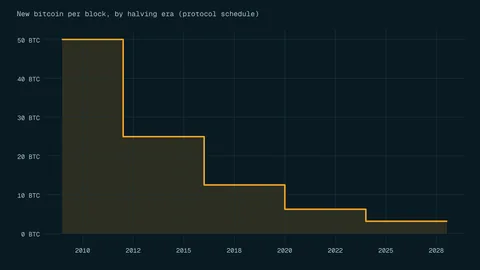
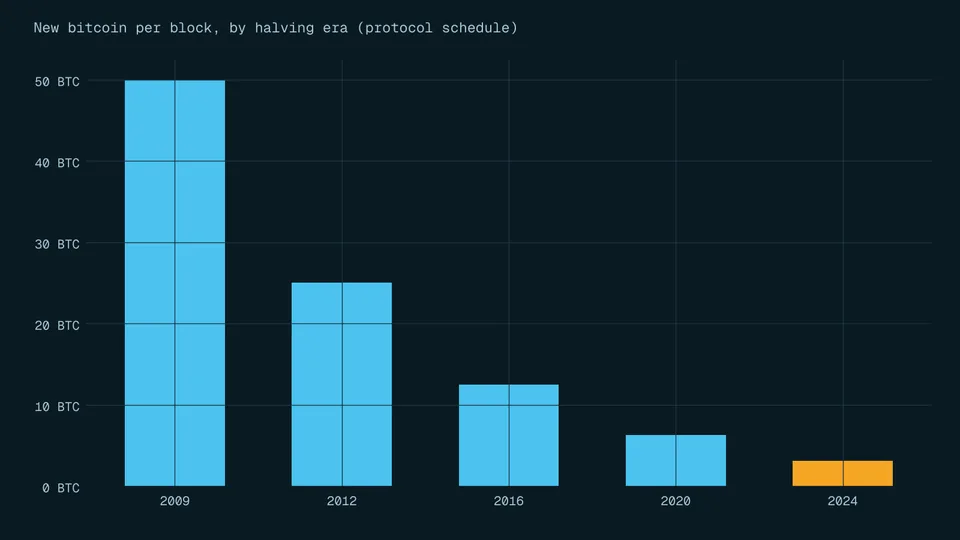
Applying the rule block by block gives the schedule below. Each era lasts 210,000 blocks, so the coins created in an era are 210,000 times that era's reward: 10,500,000 BTC in the first era, 5,250,000 in the second, and so on, as the chart shows. Half of everything the schedule can ever create comes from the first era alone (calculated).
| Era and first block | Reward per block | Cumulative share of all scheduled coins |
|---|---|---|
| Era 1, block 0 | 50 BTC | 50.00% |
| Era 2, block 210,000 | 25 BTC | 75.00% |
| Era 3, block 420,000 | 12.5 BTC | 87.50% |
| Era 4, block 630,000 | 6.25 BTC | 93.75% |
| Era 5, block 840,000 | 3.125 BTC | 96.88% |
| Era 6, block 1,050,000 | 1.5625 BTC | 98.44% |
| Era 7, block 1,260,000 | 0.78125 BTC | 99.22% |
| Era 8, block 1,470,000 | 0.390625 BTC | 99.61% |
Calculated from the 50 BTC start and 210,000-block interval [2] [3]. Shares are of the 20,999,999.9769 BTC total the schedule produces. Block numbers are positions in the chain, not dates.
Why does the total stop just short of 21 million?#
Bitcoin Core sets a maximum valid amount of 21,000,000 coins, but the code comment says this constant is a sanity check, not the total supply, which is less than 21,000,000 BTC [4].
The schedule shows one reason the numbers do not add up to a round figure. The reward is a whole number of satoshis, and halving a whole number with a right shift throws away any half-satoshi. The 50 BTC reward is 5,000,000,000 satoshis; after 32 halvings it is 1 satoshi, and the 33rd halving takes it to zero (calculated). Adding up all 33 eras gives 2,099,999,997,690,000 satoshis, or 20,999,999.9769 BTC, which is 0.0231 BTC short of 21 million (calculated).
What does a halving change for miners?#
The new-coin reward is the incentive that keeps block producers supporting the network [1], and a halving cuts it in half overnight. At the target pace of 144 blocks a day, an era paying 3.125 BTC per block creates 450 new coins a day; the next era creates 225 (calculated).
Miners have a second income: fees. The whitepaper says the difference between a transaction's inputs and outputs is a fee for the block producer, and that once a predetermined number of coins has entered circulation, the incentive can transition entirely to transaction fees [1]. The whitepaper does not say what fee level that will require, and neither does any source we use.
| Reward per block | Blocks per day | New coins per day |
|---|---|---|
| 6.25 BTC | 144 | 900 |
| 3.125 BTC | 144 | 450 |
| 1.5625 BTC | 144 | 225 |
The 10-minute spacing is a target, not an observed average, so actual daily issuance can differ [3].
Does the halving make the price go up?#
You will see this claim everywhere. None of the primary sources we rely on supports it. The Bitcoin Core code sets the reward and says nothing about markets [2]. What regulators do say points the other way: the SEC calls bitcoin a highly speculative investment and tells investors to consider its price volatility [5], and the CFTC says virtual currency value is derived entirely from supply and demand [6]. A smaller flow of new coins is only the supply half of that.
The crowd effect is real, though. A BIS study across 95 countries found that when the price of bitcoin rises, more people download and use crypto exchange apps, and it estimated that 73% to 81% of retail investors likely lost money on their initial investment [7]. Countdown headlines are exactly the kind of moment our page on fomo trading is about.
Mistakes beginners make with the Bitcoin halving#
- Expecting it on an exact date
Halvings are tied to block 210,000, 420,000 and so on. The 10-minute spacing is only a target [3], so the calendar date is not fixed in advance.
- Thinking miners stop being paid
Fees continue, and the whitepaper says the incentive can move entirely to fees once a set number of coins has entered circulation [1].
- Believing exactly 21 million will exist
The code says the 21 million constant is a sanity check and the supply is less [4]. The schedule tops out at 20,999,999.9769 BTC (calculated).
- Sizing a bet around the hype
If you buy at all, decide the amount you can lose first. Our guide to position sizing shows how.
Frequently asked questions#
How often does the Bitcoin halving happen?
What is the block reward after a halving?
Divide the block height by 210,000, drop the remainder, and halve 50 BTC that many times [2]. For block 1,000,000 that gives 3.125 BTC (calculated).
What happens when all bitcoins are mined?
No new coins are created, and block producers rely on transaction fees. The whitepaper says the incentive can then transition entirely to fees [1].
Can the halving schedule be changed?
Our sources do not describe a process for changing it. The rules live in the software the network runs, and the Bitcoin Core code notes that even its 21 million sanity constant is consensus critical, so changing it could lead to a fork [4].
The bottom line#
The halving is a simple, public rule: every 210,000 blocks the new-coin reward per block is cut in half, from 50 BTC at the start towards zero, with total issuance ending just under 21 million. That is what changes. What does not change is the risk: the price is still set by supply and demand, regulators still call bitcoin highly speculative, and a well-advertised event is no edge. For a two-line halving definition, see our glossary, and read the risk disclosure before putting money into any crypto asset.
Sources
- Bitcoin: A Peer-to-Peer Electronic Cash System.
- bitcoin/src/validation.cpp (Bitcoin Core, master branch) - function GetBlockSubsidy.
- bitcoin/src/kernel/chainparams.cpp (Bitcoin Core, master branch) - CMainParams.
- bitcoin/src/consensus/amount.h (Bitcoin Core, master branch).
- Exchange-Traded Products (ETPs) Providing Exposure to Bitcoin and Ether - Investor Bulletin.
- Customer Advisory: Understand the Risks of Virtual Currency Trading.
- Crypto trading and Bitcoin prices: evidence from a new database of retail adoption (BIS Working Papers No 1049).
- What To Know About Cryptocurrency and Scams.
- Crypto: The basics | FCA (InvestSmart).
Education only. This page is not investment, tax or legal advice. Trading and crypto can lose you money. See our risk disclosure.