Glossary
Halving: Bitcoin's reward cut in half
The halving is written into Bitcoin's code, so everyone can see it coming. What it changes is the supply of new coins, not the price.
A halving is the scheduled point at which the number of new bitcoins created with each block is cut in half. It happens every 210,000 blocks, which the Bitcoin software says is approximately every four years.
Quick answer
A halving cuts Bitcoin's new-coin reward per block in half. The reward started at 50 BTC and, in the words of the Bitcoin Core code, is cut in half every 210,000 blocks, approximately every 4 years [2]. The code says nothing about price.
Key points
On this page
What is a halving in crypto?#
New bitcoins are created as a reward for whoever adds each block to the blockchain. The Bitcoin whitepaper describes this reward as the way coins enter circulation when there is no central authority to issue them [1]. The halving is the rule that makes that reward shrink over time.
In the Bitcoin Core source code the reward, called the block subsidy, starts at 50 coins, and a comment states that it is cut in half every 210,000 blocks, which will occur approximately every 4 years [2]. The 210,000 figure is a fixed setting of the main Bitcoin network [3].
The code works in blocks, not calendar dates. The software targets one block every 10 minutes [3]. At exactly that pace, 210,000 blocks would take about 1,458 days, just under four years (calculated). Blocks do not arrive at exactly that pace, which is why the code says "approximately".
What does the reward schedule look like?#
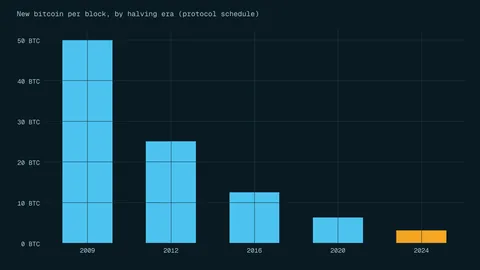
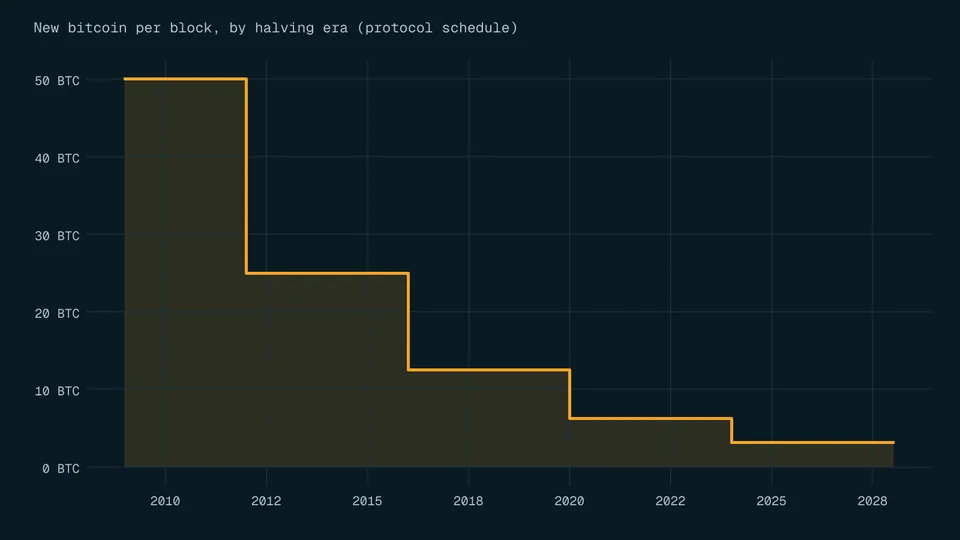
Each era of 210,000 blocks pays half the reward of the one before, so each era also creates half as many new coins. The first era creates 10,500,000 BTC, the second 5,250,000, and so on (calculated).
| Era | First block | Reward per block | New coins in the era |
|---|---|---|---|
| Era 1 | 0 | 50 BTC | 10,500,000 |
| Era 2 | 210,000 | 25 BTC | 5,250,000 |
| Era 3 | 420,000 | 12.5 BTC | 2,625,000 |
| Era 4 | 630,000 | 6.25 BTC | 1,312,500 |
| Era 5 | 840,000 | 3.125 BTC | 656,250 |
| Era 6 | 1,050,000 | 1.5625 BTC | 328,125 |
The first six eras, calculated from the 50 BTC starting reward [2] and the 210,000-block interval [3]. Block numbers, not dates: our sources do not give calendar dates for past halvings.
The halving cannot go on forever. Bitcoin amounts are counted in whole satoshi, so a 50 BTC reward of 5,000,000,000 satoshi reaches zero after 33 halvings (calculated). The code also has a backstop that forces the reward to zero after 64 halvings [2]. Adding up every era in whole satoshi gives 20,999,999.9769 BTC, just under 21 million (calculated). That matches the code comment on the 21,000,000 limit, which calls it a sanity check and says the actual supply is less than that [4]. Once new coins stop, the whitepaper says the incentive for block producers can move entirely to transaction fees [1].
Does a halving make the price go up?#
You will often read that it does. None of the primary sources we rely on supports that. The Bitcoin Core code sets the reward and says nothing about markets [2]. The US Securities and Exchange Commission (SEC) describes bitcoin and ether as highly speculative and volatile [5], and the UK FCA says crypto investors should be prepared to lose all their money [6].
A halving is public years in advance, so it is not hidden information. Anyone selling you a "halving trade" is giving you an opinion, not a fact from the code. For the longer explanation, read the Bitcoin halving: what changes and what doesn't, and see why crypto is so volatile.
Frequently asked questions#
When is the next Bitcoin halving?
It happens at the next block height divisible by 210,000 [3]. The date depends on how fast blocks actually arrive, so any calendar date is an estimate. Our sources do not give dates for past or future halvings.
Do other cryptocurrencies have halvings?
Our sources only cover Bitcoin's rule. If another coin claims a similar schedule, check its own published code or documentation rather than a promoter's summary.
Does the halving affect people who just hold bitcoin?
Not directly. It changes how many new coins block producers receive. Your coins stay the same number. Their price can still rise or fall, as with any volatile crypto asset [5].
The bottom line#
A halving is a fixed rule in Bitcoin's code that cuts the new-coin reward in half every 210,000 blocks. You can work out the reward for any block yourself, but no rule tells you what the price will do. Read the risk disclosure before you buy any crypto.
Sources
- Bitcoin: A Peer-to-Peer Electronic Cash System.
- bitcoin/src/validation.cpp (Bitcoin Core, master branch) - function GetBlockSubsidy.
- bitcoin/src/kernel/chainparams.cpp (Bitcoin Core, master branch) - CMainParams.
- bitcoin/src/consensus/amount.h (Bitcoin Core, master branch).
- Exchange-Traded Products (ETPs) Providing Exposure to Bitcoin and Ether - Investor Bulletin.
- Crypto: The basics | FCA (InvestSmart).
Education only. This page is not investment, tax or legal advice. Trading and crypto can lose you money. See our risk disclosure.