Glossary
CFD meaning: what a contract for difference is
CFDs let you bet on a price moving up or down without buying the asset. That convenience comes with leverage, ongoing costs and a provider on the other side of every trade.
A CFD (contract for difference) is a derivative contract with a provider that settles the difference between an asset's price when you open the trade and when you close it. You never own the asset, and CFDs are usually traded with leverage.
Quick answer
A CFD is a contract with a provider that pays out the difference between an asset's opening and closing price [1]. You do not own the asset. Gains and losses are based on the full position, not your margin, so losses can exceed what you put in [1].
Key points
- Profit or loss depends on the price difference between opening and closing the CFD [1].
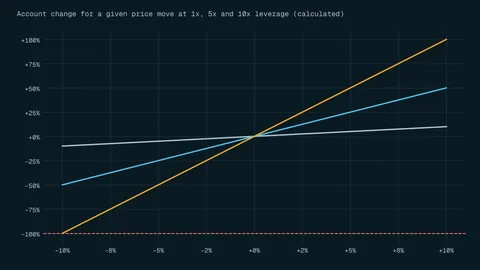
- With $500 of margin controlling a $10,000 position, a 2% move against you costs $200, or 40% of the margin (calculated).
- Costs often include spreads, commissions and overnight financing, which ASIC says can be high [1].
On this page
What is a CFD in plain words?#
A contract for difference is a type of derivative. Its value is based on an underlying asset such as shares, commodities, currencies, crypto assets or market indices, but you never own that asset [1]. Instead you make a contract with a provider. ESMA describes it as an agreement to exchange the difference between the current price of the asset and its price when the contract is closed [2]. If that difference is in your favour the provider pays you; if not, you pay the provider [2].
You can open a CFD in either direction. If you buy and the price rises you profit, and if it falls you lose. If you sell and the price falls you profit, and if it rises you lose [1]. Selling first works like short selling.
| Your trade | Price rises | Price falls |
|---|---|---|
| Buy (go long) | Profit | Loss |
| Sell (go short) | Loss | Profit |
Source: ASIC Moneysmart [1]. Costs reduce every result.
How does leverage change a CFD result?#
CFDs are traded on margin: a small deposit opens a much larger position, and your gains and losses are based on the full value of that position, not on the margin [1]. ASIC's own example uses $500 of margin to open a position worth $10,000 [1]. That is 20 times the deposit, or 20:1 leverage (calculated).
What does a CFD cost, and who loses?#
CFD trading often comes with commissions, spreads and overnight financing fees, and ASIC says these can be high [1]. ESMA also lists daily and overnight financing costs, so a position held for weeks keeps adding charges [2]. Our trading cost calculator adds these up for one trade, and trading fees explained covers each cost.
The loss figures are stark. ASIC research found at least 68% of retail investors lost money trading CFDs in 2023-24 [1]. In 2018, ESMA reported that national regulators' studies found 74-89% of retail CFD accounts typically lost money [3]. Aiming at products with excessive risk features that harm retail consumers, the UK FCA in 2019 made firms limit leverage, close out positions when funds fall to 50% of the margin needed, and cap a client's loss at the money in the account [4]. In the UK, a ban on selling crypto CFDs to retail consumers took effect on 6 January 2021 [5], and the current FCA Handbook still prohibits it [6]. For the full picture, read what is a CFD, and why do most retail accounts lose?
Frequently asked questions#
Do you own the shares when you trade a share CFD?
No. ASIC says that when you trade a CFD you do not own the underlying asset; you have a contract with the provider [1].
Can you lose more than you deposit with a CFD?
Are CFDs traded on an exchange?
ASIC says CFDs are not traded on a licensed exchange, so you rely on the CFD issuer to meet its obligations to you [1].
The bottom line#
A CFD is a leveraged bet on a price difference, settled with a provider rather than on an exchange. Small moves become large gains or losses on your margin, costs build up while you hold, and most retail accounts in regulators' studies lost money. Read the risk disclosure before you consider one.
Sources
- Contracts for difference (CFDs) - Moneysmart.gov.au.
- Contracts for difference (CFDs).
- ESMA agrees to prohibit binary options and restrict CFDs to protect retail investors.
- PS19/18: Restricting contract for difference products sold to retail clients.
- FCA bans the sale of crypto-derivatives to retail consumers.
- COBS 22.6 Prohibition on the retail marketing, distribution and sale of cryptoasset derivatives and cryptoasset exchange traded notes (FCA Handbook).
Education only. This page is not investment, tax or legal advice. Trading and crypto can lose you money. See our risk disclosure.