Explainer · Trading Basics
Long and short positions, explained with one trade
Going long means you gain if the price rises. Going short means you gain if it falls. The two sound like mirror images, but their risks are not: one has a floor on its loss and the other does not.
Quick answer
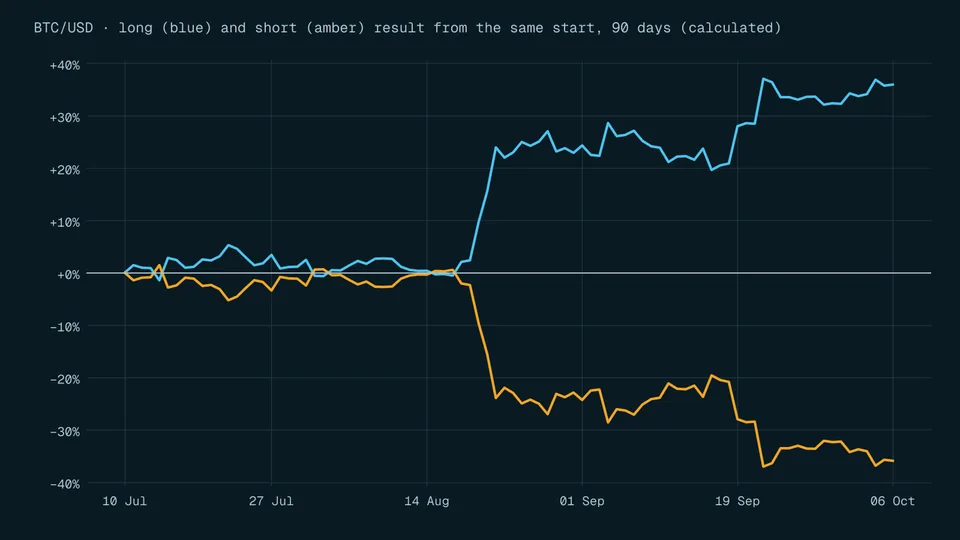
A long position means you own the asset and gain if its price rises [1]. A short position means you sell something you do not own, usually borrowed, hoping to buy it back cheaper. A long loss stops at what you paid; a short loss has no ceiling [3].
Key points
- Long means you own the security and expect it to rise [1].
- Short means you sell first, usually with borrowed shares, and buy back later [3].
- A long loss is limited to the amount invested; a short loss is theoretically unlimited [3].
- Shorting costs money while you hold it: interest on the loan and any dividends owed to the lender [3].
- Short 10 shares at $60 and a rise to $180 costs $1,200, twice the $600 you sold for (calculated).
On this page
What do long and short mean?#
The SEC's definitions are short. Having a long position in a security means you own it, and investors hold long positions expecting the price to rise [1]. A short position is generally the sale of a stock you do not own [1]. If the price then drops, you can buy it back lower and keep the difference; if it rises and you buy back higher, you take a loss [1].
The CFTC's futures glossary uses the same words for contracts: a long is someone who has bought a futures contract to establish a market position, and the short is the selling side of an open futures contract [2]. So "long" and "short" describe which way you profit, not which product you use.
| Long | Short | |
|---|---|---|
| First action | Buy | Sell (usually borrowed shares) |
| Gains when | Price rises | Price falls |
| Worst case | Lose what you paid [3] | No ceiling on the loss [3] |
| Ongoing costs | Margin interest only if you borrow | Loan interest, dividends to the lender [3] |
| Who it suits | Owners and most beginners | The SEC calls it for the experienced investor [1] |
How does a long position make or lose money?#
Take the stock price from the SEC's own short-sale example, $60 a share [3], and look at it from the buyer's side first. You buy 10 shares for $600. Every $1 the price moves changes your result by $10.
If the price rises to $80, the position is worth $800 and you are up $200. If it falls to $40, you are down $200. The worst case is that the company fails and the shares become worthless: you lose the full $600, and no more, as long as you did not borrow to buy (calculated). That floor is why the SEC describes a long position's risk as limited to the amount invested [3].
Borrowing changes this. If you buy with a margin loan, a large fall can cost more than the cash you put in. Our guide to leverage and margin explained shows how.
How does a short sale work, step by step?#
Short selling a stock usually involves borrowing it. The SEC explains that your brokerage firm typically lends you the shares, charges interest on the loan, and that you are subject to the margin rules [3]. The SEC's worked example uses a stock at $60 [3]; we use 10 shares.
- Borrow the shares
Your broker lends you 10 shares. You now owe 10 shares, not a fixed amount of money.
- Sell them at $60
You receive $600 (calculated). This is not profit: you still have to return the shares.
- Hold the position and pay its costs
Interest on the loan runs while you wait, and if the company pays a dividend you must pay it to the lender [3].
- Buy the shares back
At $40 you pay $400 and keep $200. At $80 you pay $800 and lose $200 (calculated, before costs). The SEC's own example gives the same $20 per share either way [3].
- Return the shares
The borrowed shares go back to the lender and the position is closed.
Why can a short position lose more than you put in?#
Because a price can fall only to zero but can rise without limit. The SEC puts it plainly: shorting a stock leaves an investor open to the possibility of unlimited losses, since a stock can theoretically keep rising indefinitely [3]. A long position's loss stops at what you paid. A short position's loss keeps growing with every dollar the price climbs.
The table runs the same 10-share position at different prices.
| Price later | Price change | Long result | Short result |
|---|---|---|---|
| $0 | -100% | -$600 | +$600 |
| $30 | -50% | -$300 | +$300 |
| $40 | -33.3% | -$200 | +$200 |
| $60 | 0% | $0 | $0 |
| $80 | +33.3% | +$200 | -$200 |
| $120 | +100% | +$600 | -$600 |
| $180 | +200% | +$1,200 | -$1,200 |
The short's best case is +$600, if the price goes to zero. Its worst case has no limit.
What does it cost to hold a short position?#
A long position in shares you paid for in full costs nothing to hold. A short position costs money every day it stays open. The SEC lists the main items: interest on the share loan, margin rules, and any dividend the stock pays, which you must pass to the lender [3]. Transaction costs come off the result in both directions [3].
Margin rules matter because a rising price eats into your account. Under US margin rules a broker can sell your securities without consulting you first, and you cannot choose which ones it sells [6]. Our page on the margin call explains the process.
- Cash from the sale
- $60010 shares x $60, calculated
- Best possible result
- +$600price falls to $0, calculated
- Result if price doubles
- -$600buy back at $120, calculated
- Dividend owed on a $0.50 payout
- $510 x $0.50, example dividend, calculated
How does going short work in futures, forex and CFDs?#
The borrowing steps above are the SEC's description for stocks. Other products use contracts, and the CFTC defines short selling more broadly as selling a futures contract or other instrument with the idea of delivering on it or offsetting it at a later date [2].
In over-the-counter forex, the CFTC notes that when you sell, your dealer is the buyer [7], so a sell order opens a position that is the dealer's opposite. CFDs are what the UK regulator calls complex, leveraged derivatives [8], and each provider sets its own contract terms. With leverage, the loss is measured against the full position, not your deposit: the CFTC warns that forex traders may be liable for losses beyond their initial deposit [7]. Read what is a cfd before trying either.
We do not have a regulator source on how each product charges for holding a short, so check the contract terms and financing costs with your provider.
Mistakes beginners make with long and short positions#
- Treating short as the mirror of long
The gain on a short is capped at the sale value; the loss is not [3]. The two sides do not carry equal risk.
- Counting the sale proceeds as profit
The $600 from a short sale is borrowed value. You still owe the shares, whatever they cost later.
- Forgetting the carrying costs
Loan interest and dividends owed to the lender reduce the result every day the short is open [3].
- Trusting a stop to cap the loss
A stop becomes a market order and can fill far from its price [4].
- Shorting as a first trade
The SEC says short selling is for the experienced investor [1]. Learn how a long position, costs and position size work first.
Frequently asked questions#
Is going short the same as short selling?
In stocks, yes: going short means a short sale, usually of borrowed shares [3]. In futures and other contracts, it means selling the contract with the plan to offset it later [2]. Our glossary entry on short selling has the short version.
Can I lose more than I invested on a long position?
Why would anyone short a stock?
The SEC lists three reasons: to profit from an expected price drop, to provide liquidity when buyers appear unexpectedly, and to hedge the risk of a long position [3].
The bottom line#
A long position gains when prices rise and can lose no more than you paid, unless you borrow. A short position gains when prices fall, costs money to hold, and has no ceiling on its loss. If you ever short, size it from the loss you can accept, assume a stop may fill worse than planned, and read the risk disclosure first. The next step is knowing what can you trade and how each market lets you go long or short.
Sources
- Stock Purchases and Sales: Long and Short.
- CFTC Glossary: A Guide to the Language of the Futures Industry.
- Investor Bulletin: An Introduction to Short Sales.
- Stop, Stop-Limit, and Trailing Stop Orders (Investor Bulletin).
- Order Types.
- Investor Bulletin: Understanding Margin Accounts.
- Customer Advisory: Eight Things You Should Know Before Trading Forex.
- PS19/18: Restricting contract for difference products sold to retail clients.
- Options.
Education only. This page is not investment, tax or legal advice. Trading and crypto can lose you money. See our risk disclosure.