News analysis ·
Prediction Markets on Jensen Huang: What the Odds Mean
Kalshi and Polymarket price low odds of Jensen Huang leaving Nvidia. How these event contracts settle, and why the fine print matters.
Nvidia's board is investigating chief executive Jensen Huang, and traders on Kalshi and Polymarket have already put a price on whether he leaves. CNBC reported that both markets see an exit in the near term as unlikely. This article looks at what those prices actually measure, how each contract settles, and where a small trader can lose money on a bet like this.
What happened at Nvidia
According to CNBC, the Nvidia board opened its probe after reports that Huang had been the target of a foreign intelligence effort. On Sunday, Huang acknowledged an extramarital affair. The New York Times reported that US intelligence officials say the woman works for China's Ministry of State Security.
Nvidia shares fell more than 5% on Monday after the news. CNBC reported that traders on prediction markets see an ouster of Huang as unlikely.
What are prediction markets, and what did they price here?
A prediction market lets people buy contracts on a yes-or-no question. A contract pays a fixed amount if the answer turns out to be yes and nothing if it is no. Its price moves between zero and that fixed amount, so the price is often read as the crowd's estimate of the chance.
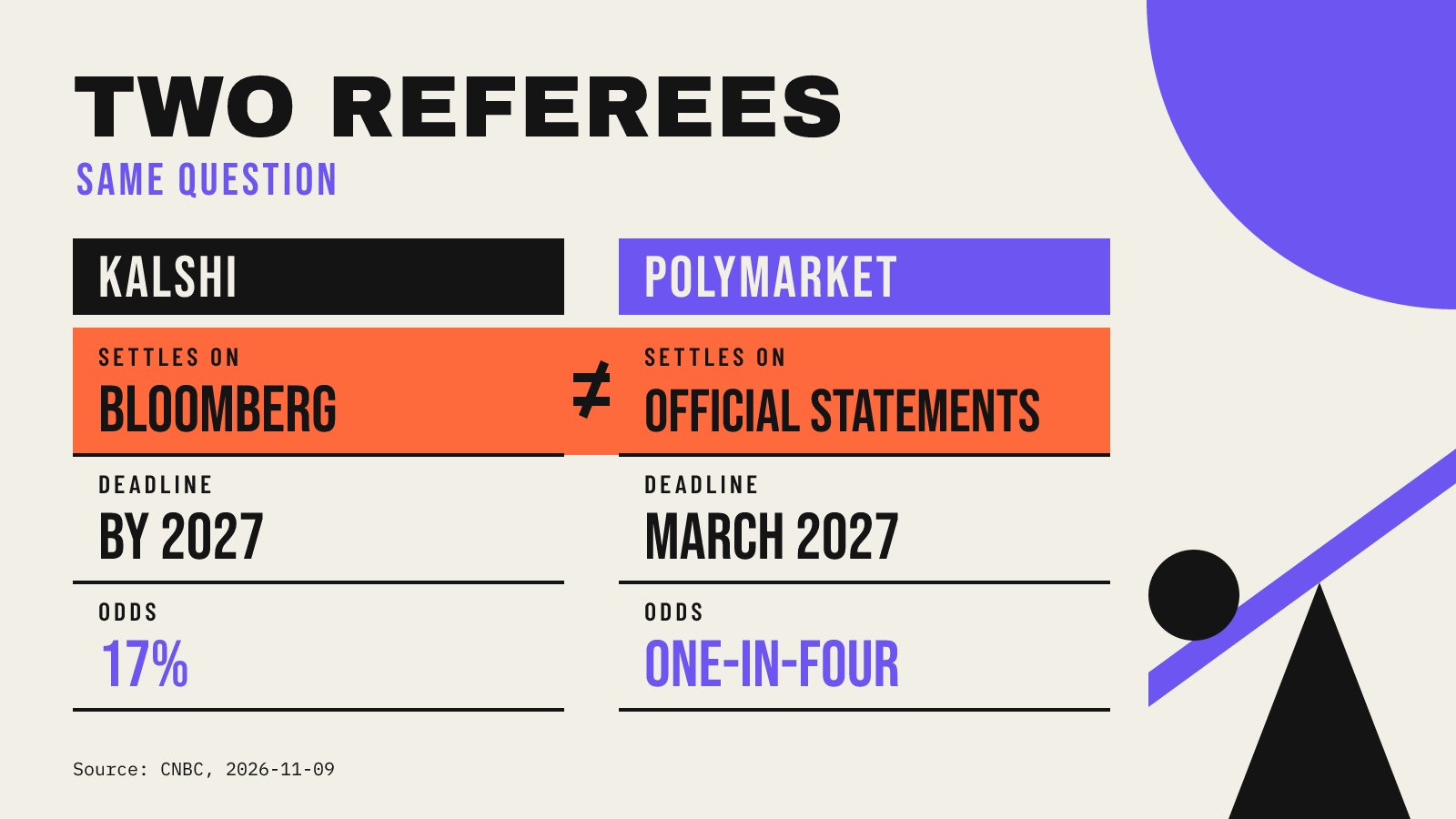
On Kalshi, CNBC reported, prices implied a 17% chance that Huang is gone by 2027, 30% by 2028 and 35% by 2029. The same market put the chance of a departure by 2031 at 75%. On Polymarket, speculators priced a one-in-four chance that he resigns or is forced out before the end of March 2027.
The mechanics: the settlement rule is the product
The headline number is only half of a contract. The other half is the resolution rule: the exact wording of the question, the deadline, and the source that decides the answer. Two contracts that sound alike can pay out differently because of those details.
Here the two platforms use different referees. CNBC reported that Kalshi settles its Huang contracts using information from Bloomberg. Polymarket resolves on official statements from Nvidia or from Huang himself. Polymarket's question also names a specific path, resignation or forced removal, with a deadline at the end of March 2027, while the Kalshi contracts are tied to whether he is gone by a given year.
That is why the two prices should not be read as one consensus. A gap between them can reflect different deadlines, different wording and different settlement sources, not only different opinions. It can also reflect thin trading. A market with few active buyers and sellers can show a price that moves a lot on a small order.
Each date on Kalshi is its own contract. The 2031 contract is not a forecast for 2027 stretched out; it is a separate bet with its own price, its own liquidity and its own spread, the gap between what buyers bid and what sellers ask.
Where the risk is
Event contracts look simple, but there are several ways to lose money on a question like this one.
- Wording risk: an exit that happens in an unexpected form or just after the deadline can leave a correct hunch on the losing side of the contract.
- Settlement risk: if the named source, such as a news service or a company statement, is late, vague or silent, resolution can be delayed or disputed while your money sits locked.
- Price risk before settlement: if you sell early, you get the market price of the day, which can swing hard on a single headline, and a wide spread raises your cost on the way in and out.
- Information risk: insiders, lawyers and people close to the board may know more than a retail trader reading the news, and you could be the less-informed side of every trade.
There is also the matter of who tells you the odds. CNBC disclosed a business tie with Kalshi: the deal covers bringing in customers and also involves a minority investment. That does not make the numbers wrong, but readers should know when a publisher has a business tie to the market it is quoting.
What to watch
The next signals come from the board's investigation and from any statement by Nvidia or Huang. Under Polymarket's rules, such a statement is exactly what decides the contract. For Kalshi traders, what Bloomberg reports is the key input.
Anyone looking at a question like this has more to read than the price: the full rules page, the deadline, the settlement source, how many contracts change hands and how wide the spread is. A trader can lose the whole stake, because a contract that settles at no pays nothing.
Sources
- CNBC, 9 Nov 2026
Drafted with an AI model using only the sources listed, and released automatically after software checks on figures and originality. Nobody edited it by hand. For learning only; it does not tell you what to buy or sell.