News analysis ·
CME's bitcoin cash and uniswap futures: the risks
CME Group plans bitcoin cash and uniswap futures, pending review. How futures on smaller coins work and where leverage can hurt retail traders.
CME Group plans to list futures on bitcoin cash and uniswap, with trading set to start on Monday if a regulatory review clears them, according to CoinDesk. A listing on a large, regulated exchange can sound like a safety stamp. This article looks at what a futures contract on a smaller coin actually is, and where a retail trader could lose money with one.
What CME Group announced
CoinDesk reported the plan on 2026-10-19 in its Crypto Week Ahead calendar, a weekly list of upcoming crypto and macroeconomic events. CoinDesk describes CME Group as one of the largest derivatives exchanges in the world. The new contracts would track bitcoin cash, ticker BCH, and uniswap, ticker UNI. CoinDesk quoted bitcoin cash at $279.21.
Two points matter before anyone treats this as settled. First, the launch still depends on a regulatory review, so the start date is a plan, not a certainty. Second, the CoinDesk item does not give the contract size, the margin requirement or how the contracts settle. Those three details decide how much one contract exposes a trader to, so they are worth reading in the exchange's own specifications before any trade.
The mechanics: what a futures contract on a coin is
A futures contract is an agreement to buy or sell an asset at a set price on a later date. Most traders never hold the coin itself. They hold a contract whose value rises and falls with the coin's price, and they close it before it expires or let it settle at the end.
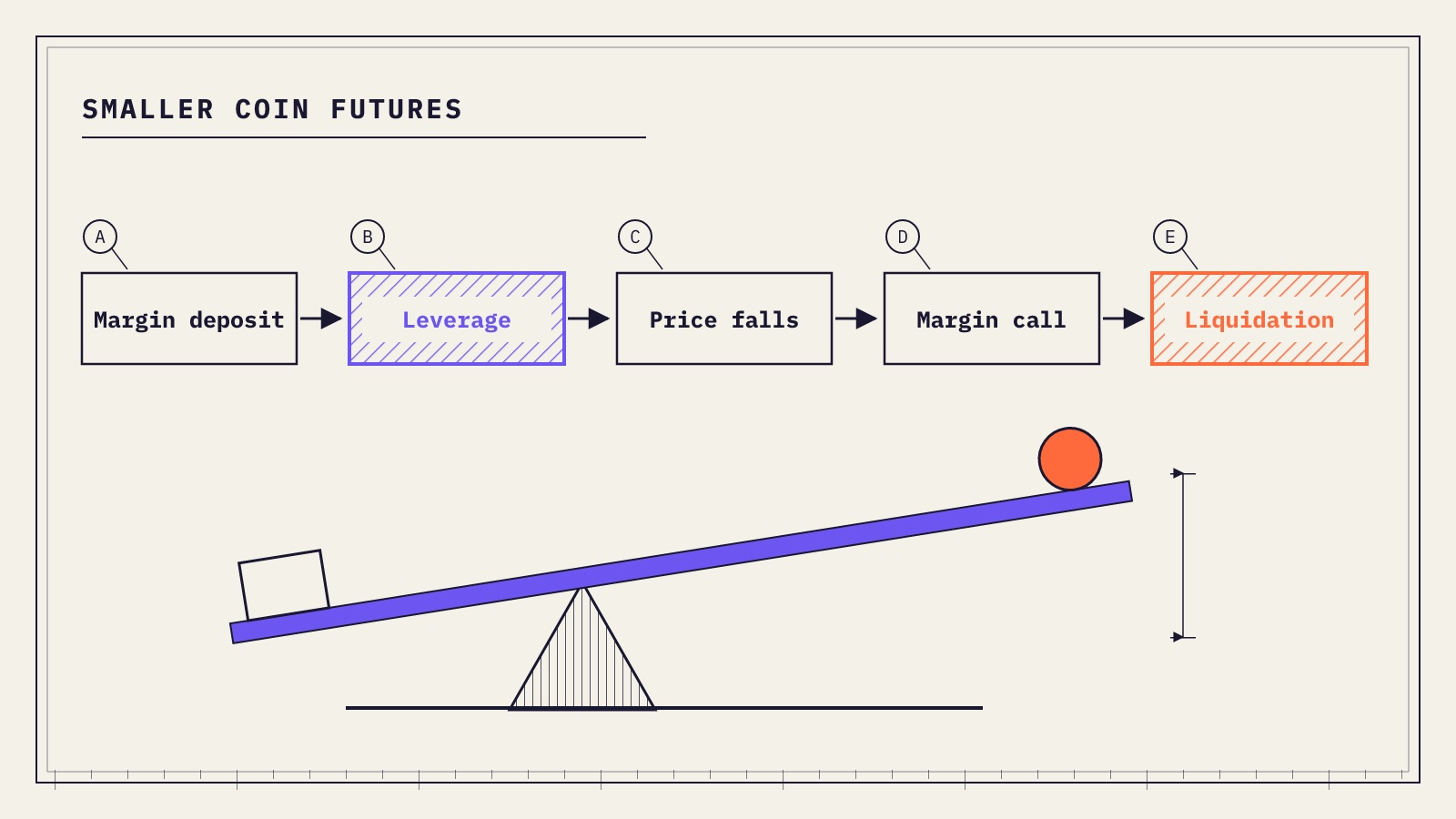
Futures use margin. Margin is the deposit the exchange or broker asks for to open a position. It is only a fraction of the position's full value, which is what creates leverage: a bigger position than your deposit. If the price moves against you, losses come out of that deposit. When the deposit falls below a required level, the broker asks for more money, which is a margin call. If you cannot add funds, the broker can close the position for you. That forced exit is called liquidation.
This is why a futures contract on a coin behaves very differently from owning the coin. If you buy a coin outright and it falls, you can wait. With a leveraged futures position, a sharp move can end the trade before you have any choice, and the loss can exceed what you expected when you opened it.
Where the risk is
Bitcoin cash and uniswap are smaller and less traded than bitcoin. Smaller assets often have thinner liquidity, meaning fewer buyers and sellers at each price. Thin liquidity tends to come with wider spreads and larger price jumps. When those features meet leverage, the result can be fast losses. A regulated exchange sets the rules of the contract, but it does not make the underlying coin any less volatile.
- Leverage magnifies moves: a modest swing in the coin can wipe out a large share of the margin deposit, or all of it.
- Liquidation can happen at a bad price: in a fast or thin market, the forced exit may fill well away from the last price you saw.
- Gaps between sessions: if the futures market is closed while the coin keeps trading elsewhere, the price can open far from where it closed, skipping any stop-loss level.
- Unknown terms: until the contract size, margin and settlement rules are published and read, a trader cannot know how much one contract really puts at risk.
Retail traders usually reach these contracts through a futures broker, which may set its own margin rules on top of the exchange's. The broker's terms, not only the exchange's, decide when a margin call or liquidation happens to your account.
What to watch
The first thing to watch is whether the regulatory review clears and the contracts actually start trading. After that, the published contract specifications are the key document: contract size, initial and maintenance margin, trading hours and settlement method. A trader who cannot explain each of these in plain words is not yet in a position to size a trade. Early trading volume is also worth watching, because new contracts can start with little activity, which means wider spreads and less reliable fills.
Sources
- CoinDesk, 19 Oct 2026
Drafted with an AI model using only the sources listed, and released automatically after software checks on figures and originality. Nobody edited it by hand. For learning only; it does not tell you what to buy or sell.