Glossary
Lot size: how big one trade really is
On many trading platforms you do not type an amount of money. You pick a number of lots. Knowing what one lot is worth is the difference between a small trade and a very large one.
A lot is a unit of trading: the fixed quantity a platform or exchange uses when you choose how much to buy or sell. In forex, a lot is a number of units of the first currency in the pair.
Quick answer
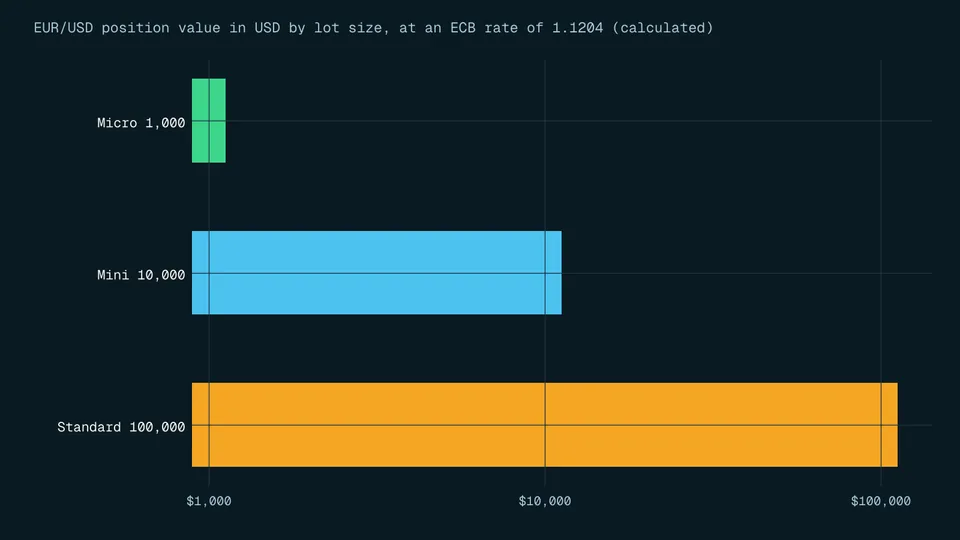
A lot is a unit of trading [1]. A CFTC order describes forex lots of 100,000 units of the base currency, where one pip was worth $10 for pairs quoted in U.S. dollars [2]. At a price of 1.1000, one such lot controls $110,000 (calculated). Check the lot size on your platform.
Key points
- A lot is a unit of trading [1]; how many units one lot holds depends on the product, so check it on your platform.
- One lot of 100,000 units at 1.1000 is a $110,000 position, even if the deposit is $2,200 (calculated).
- Leverage means losses are counted on the full position, and can exceed your deposit [4].
On this page
What is a lot in trading?#
The CFTC glossary defines a lot simply as a unit of trading [1]. It is the standard block in which a product is bought and sold. In forex, the block is a number of units of the base currency, the first currency in the pair.
A CFTC enforcement order gives a concrete case: a firm sold currency pairs in lot sizes of 100,000 units of the base currency, and one pip was worth $10 for currencies quoted in U.S. dollars [2]. That order describes one firm, so treat 100,000 as an example, not a rule. The contract details on your own platform tell you what "1 lot" means there.
- Find the contract size
Open the product's details on your platform and note how many units one lot contains.
- Convert to money
Multiply units by the current price to get the position value you control.
- Work out the pip value
Multiply units by the pip size, for example 100,000 x 0.0001 = $10 for a pair quoted in dollars (calculated).
- Compare with your account
Check the loss at your stop against what you can afford to lose before you place the order.
How big is one lot in money?#
Much bigger than the deposit suggests. U.S. rules require a minimum security deposit of 2% of notional value for major currency pairs and 5% for other pairs [3]. The table shows what that means for three position sizes at a price of 1.1000.
| Units | Position value | 2% deposit | 5% deposit | Value of 1 pip |
|---|---|---|---|---|
| 100,000 | $110,000 | $2,200 | $5,500 | $10.00 |
| 10,000 | $11,000 | $220 | $550 | $1.00 |
| 1,000 | $1,100 | $22 | $55 | $0.10 |
Pair quoted in U.S. dollars at 1.1000, pip size 0.0001 (calculated). Deposit rates from 17 CFR 5.9 [3].
Why does lot size matter for risk?#
Profit and loss are counted on the whole position, not on your deposit. The CFTC warns that leverage amplifies losses as well as gains and that you may be liable for losses beyond your initial deposit [4]. It also reports that about two-thirds of customers at registered U.S. forex dealers lost money over the year it describes [4].
Choose the number of units from the loss you accept at your stop, not from the deposit the platform asks for. Our guide to position sizing shows the method step by step.
Frequently asked questions#
Is one lot always 100,000 units?
Does a smaller lot mean less risk?
A smaller position loses less for the same price move: on 1,000 units a pip is worth $0.10 instead of $10 (calculated). It does not change the odds of the trade; it only changes how much each pip costs.
The bottom line#
Before you choose a number of lots, turn it into money: units times price for the position, units times pip size for each pip. Compare the loss at your stop with what you can afford to lose. Try your numbers in the position size calculator and read the risk disclosure before trading with leverage.
Sources
- CFTC Glossary: A Guide to the Language of the Futures Industry.
- Order Instituting Proceedings Pursuant to Sections 6(c) and 6(d) of the Commodity Exchange Act (In the Matter of SK's Forex International, Inc. and Elizabeth Miskus Kemp).
- 17 CFR 5.9 - Security deposits for retail forex transactions.
- Customer Advisory: Eight Things You Should Know Before Trading Forex.
Education only. This page is not investment, tax or legal advice. Trading and crypto can lose you money. See our risk disclosure.