News analysis ·
Polymarket sues Ohio: what prediction market traders risk
Polymarket US took Ohio to federal court over sports event contracts. We explain how these contracts work and where state-versus-federal risk lands.
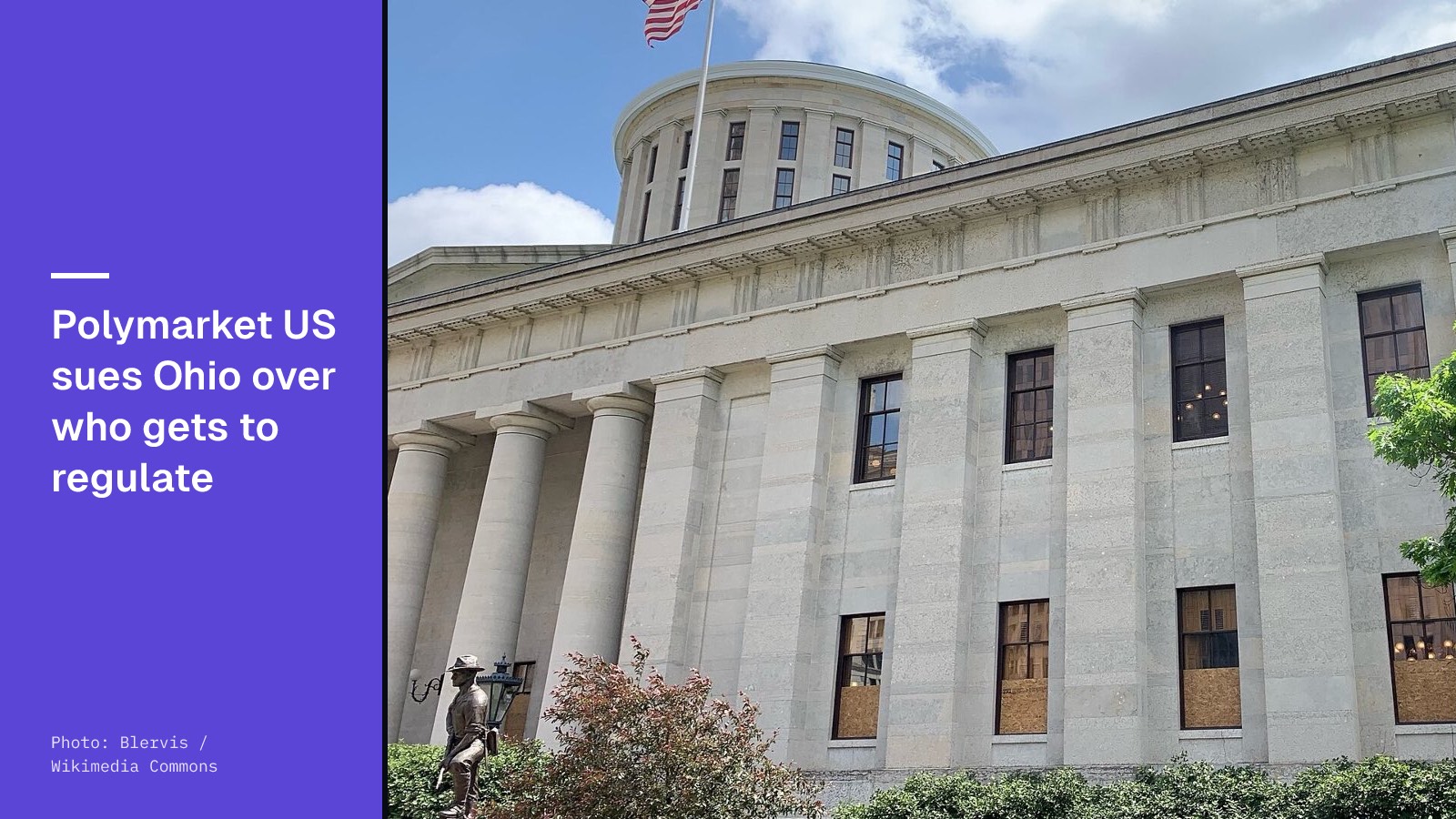
Polymarket US has taken the Ohio attorney general and the state's casino regulators to federal court, after Ohio ordered it to halt its sports contracts unless it got licensed locally, Unchained reported. The case is one more front in a fight over who gets to regulate these products. This article looks at what that fight means for the person actually holding a contract.
What happened in Ohio
According to the complaint, as described by Unchained, the Ohio Casino Control Commission sent Polymarket US a letter on Oct. 2. It demanded that the company stop offering sports event contracts unless it held an Ohio license, and it accused the company of bookmaking under state civil and criminal law.
Polymarket US was not alone. Ten companies received the notice. A commission spokesperson told SportsBettingDime that one had confirmed compliance and two had gone to court, with Polymarket reportedly among them.
Polymarket US filed its complaint on Oct. 16, the deadline Ohio had set, in the Southern District of Ohio. Judge Douglas Cole has the case. The defendants are Attorney General Andy Wilson, the seven members of the commission and its interim executive director, Andromeda Morrison.
What are prediction markets, and why do states object?
A prediction market lists event contracts: you buy a position on whether something will happen, such as the result of a game. If the outcome goes your way, the contract pays a fixed amount. If not, it pays nothing. The price you pay in between moves with what other traders think the odds are.
That shape is why the fight exists. To a commodities regulator, it looks like a financial contract traded on an exchange. To a state gambling regulator, a contract on a sports result looks a lot like a bet. Ohio's letter took the second view. Polymarket's lawsuit argues for the first.
The mechanics: two legal arguments and a split court system
Polymarket's first argument is about interstate commerce. It says Ohio's licensing rules favour firms with a physical presence in the state and would limit even licensed operators to customers inside Ohio. In the complaint's words: "These discriminatory, balkanizing measures violate the Constitution’s promise of open, interstate commerce".
The second argument is preemption, meaning federal law overrides state law in a given area. Polymarket says the Commodity Exchange Act gives the CFTC sole authority over event contracts listed on federally designated exchanges, so Ohio's gambling law should not apply.
That argument has a problem close to home. The Sixth Circuit, the federal appeals court that covers Ohio, ruled against Kalshi on preemption on Sept. 25. Polymarket says that ruling came under different conditions, pointing to two CFTC actions dated Oct. 9: an interim final rule that excludes casino-style gambling from what counts as a swap, and a proposed rule bringing event contracts into it.
Elsewhere, the Third Circuit backed Kalshi over New Jersey on the same question, and New Jersey now wants the Supreme Court to take another look. With the Sixth Circuit going the other way, the appeals courts are now split. In practice, that means whether a product is legal for you can depend on which state you are standing in.
Where the risk is for a trader
None of this changes the basic risk of an event contract: if the outcome goes against you, the contract can expire worthless. The legal fight adds a second layer of risk on top, and it has nothing to do with whether your prediction is right.
- Access can change by location. If a state order wins out, a platform may have to stop serving that state, and you may lose the ability to open new positions or manage existing ones.
- Liquidity can thin out fast. Liquidity means how easily you can buy or sell. If some traders are suddenly shut out, there are fewer people on the other side, and exiting at a fair price gets harder.
- Protections depend on the label. A product treated as a federally regulated contract and one treated as a state-licensed bet sit under different rulebooks, so the complaint process and safeguards you can rely on are not settled.
- Rules can shift mid-trade. The CFTC's Oct. 9 steps include a proposed rule that is not final, and court rulings can move the ground again while your money is in a position.
A simple habit helps here: before you deposit, check which regulator a platform answers to, whether your state is served, and what the platform says it will do with open positions if access is cut off.
What to watch next
As of Oct. 21, Polymarket US had not asked for a preliminary injunction, which is a court order that would pause enforcement while the case runs, and Ohio had not answered the complaint, Unchained reported. Either step would be the next real signal in this case.
Beyond Ohio, watch whether the Supreme Court takes up New Jersey's request, and whether the CFTC's proposed rule on event contracts is made final. Those two outcomes, more than any single state case, will decide how much of this legal risk stays attached to prediction markets.
Sources
- Unchained, 21 Oct 2026
Drafted with an AI model using only the sources listed, and released automatically after software checks on figures and originality. Nobody edited it by hand. For learning only; it does not tell you what to buy or sell.