News analysis ·
Papertrade's PAPER token rule change: the risks
Papertrade says PAPER stays non-transferable after about $140 million arrived. How the loss-reward token works and where traders carry the risk.
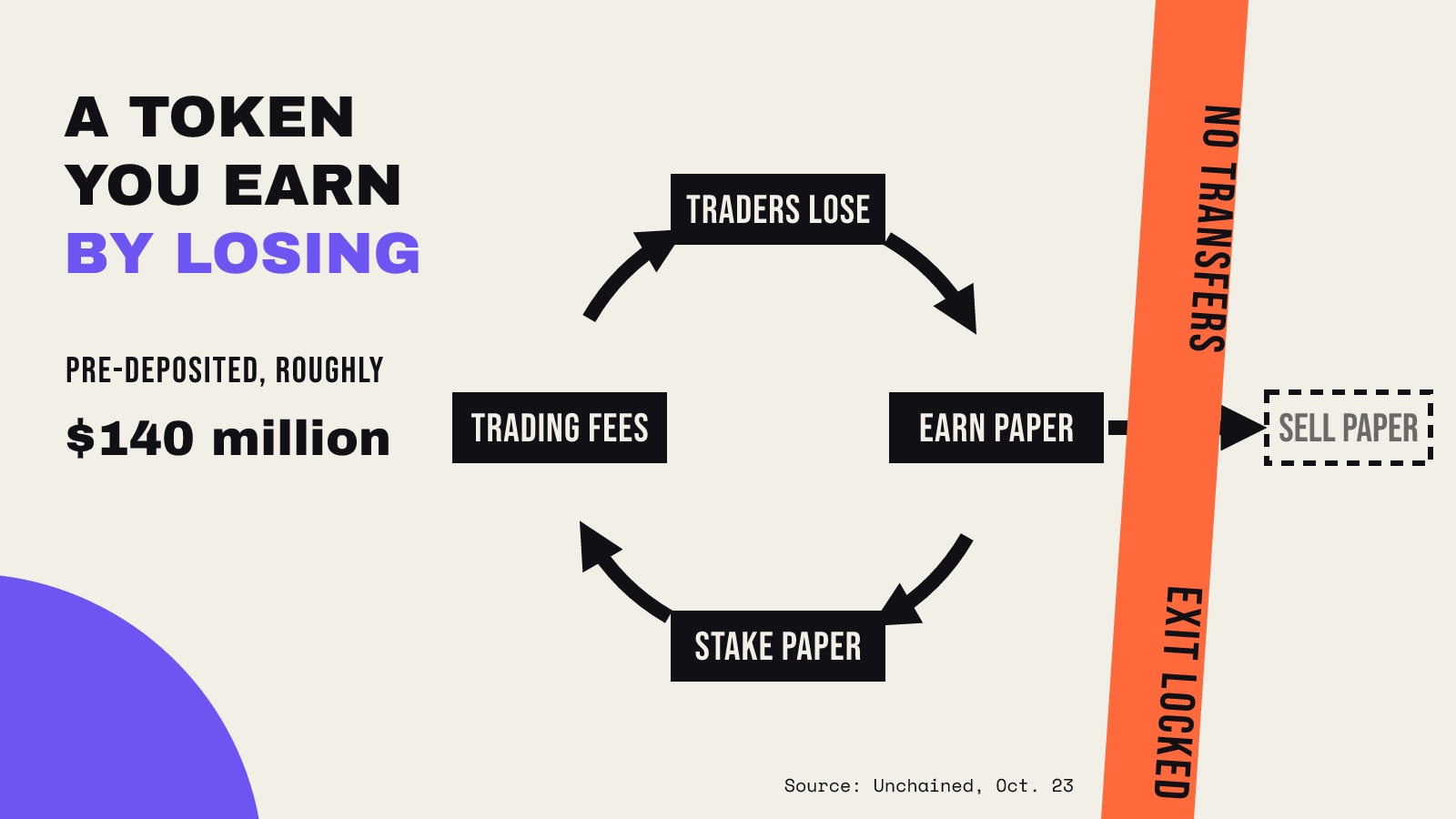
Papertrade, which runs leveraged trading on HyperEVM, the network built by Hyperliquid, said on Oct. 19 that it has no current plans to let its PAPER token move off the contract. Its launch plan had pointed to transfers in a later phase, and users had already pre-deposited roughly $140 million. This article looks at how the token works, why the team changed course, and what the change means for the people who signed up under the old terms.
What happened
Papertrade went live on Oct. 10. Its Oct. 1 launch plan described token transfers as something that would come later. On Oct. 19, after launch, the team posted that it does not plan to allow PAPER to be transferred off the contract at this stage.
The team's reason was market manipulation. According to Unchained, Papertrade argued that if traders could short PAPER, an attack on the venue would start to pay. In its own example, spending $15m to push the price of bitcoin or ether against a venue with a $10 million bankroll is not worth it on its own. Add a $10 million short on PAPER, and the same attack becomes worthwhile.
The idea of a market on PAPER did not stay hypothetical. On Oct. 18, Paragon listed a PAPER perpetual market on Hyperliquid through HIP-3, the system that lets outside parties create markets. It halted and settled that market about a minute after Papertrade's post.
The mechanics: a token you earn by losing
Papertrade gives traders PAPER tokens when they lose money. Holders can then stake PAPER, which means locking it in the contract, to collect a share of the venue's trading fees. In plain terms, the token is a claim on a share of the venue's fee income.
That design ties several risks together. The venue has a bankroll that the attack example is measured against. Fees flow to stakers. And the value of PAPER depends on fee income staying high. If someone can profit from PAPER falling, they have a reason to make the venue lose money, for example by moving the price of a large asset against its positions. That is the link the team pointed to.
Unchained reported that Delphi Digital head of markets Jason Pagoulatos agreed the threat is real. He said that on launch day, big market orders on Hyperliquid moved the ether price, and the team stepped in by hand to block the positions linked to them. He also said that capping pool size or leverage would remove most of the reasons anyone would use the venue at all. So the protection the team chose is to keep PAPER locked, rather than shrink the product.
Here is the part a news summary can skip. A token that cannot leave the contract cannot be sold to exit. Your only return is the stream of staking payouts, and that stream rises and falls with trading on the venue. According to DefiLlama data cited by Unchained, stakers had received about $57 million in total as of Oct. 21. Daily payouts were about $1.3 million on Oct. 20, fell to roughly $88,000 the next day, and on Oct. 22 were back near $1.07 million. Swings like that are the whole return for a holder who has no market to sell into.
Where the risk is
For traders and token holders, the risks sit in several places at once.
- Rule-change risk: terms you relied on when you deposited can change after the money is in. Planned features are plans, not rights.
- Exit risk: a token that cannot be transferred cannot be sold, so its value to you depends only on payouts you cannot control.
- Payout risk: fee income can drop sharply from one day to the next, as the daily figures above show.
- Leverage risk: on a high-leverage venue, a small price move against your position can wipe out your margin, and the losses that earn PAPER are real losses first.
Pagoulatos put the frustration plainly on the Oct. 22 Unchained episode: "You sell a bunch of people on a rule set beforehand, a bunch of money comes in, and now you change everything after the fact". He said the move was not quite a rug pull, but it changed the terms users signed up for. He also noted that the risk was written into the project documents in advance, and said blame is shared by everybody.
Crypto risks: what this case teaches
Many crypto risks are not about price at all. Here the main risk is that the rules of the product can be rewritten by the team that runs it. Reading the documents before depositing matters, because, as Pagoulatos noted, the warning was there.
Pagoulatos said current activity reflects organic demand rather than token farmers, meaning users who arrive only to collect a token and sell it. He said the project is not finished but faces an extremely tough road.
What to watch
Watch whether Papertrade changes its transfer policy again, and how it explains any change. Watch the daily staking payouts, since they are now the only return for PAPER holders. And watch whether new markets on PAPER appear elsewhere, since the team's case rests on stopping exactly that.
Sources
- Unchained, 23 Oct 2026
Drafted with an AI model using only the sources listed, and released automatically after software checks on figures and originality. Nobody edited it by hand. For learning only; it does not tell you what to buy or sell.