News analysis ·
Coinbase's Own Prediction Markets: What Changes for You
Coinbase reportedly plans in-house event contracts in the first half of 2027. What shifts for traders when the broker also writes the market.
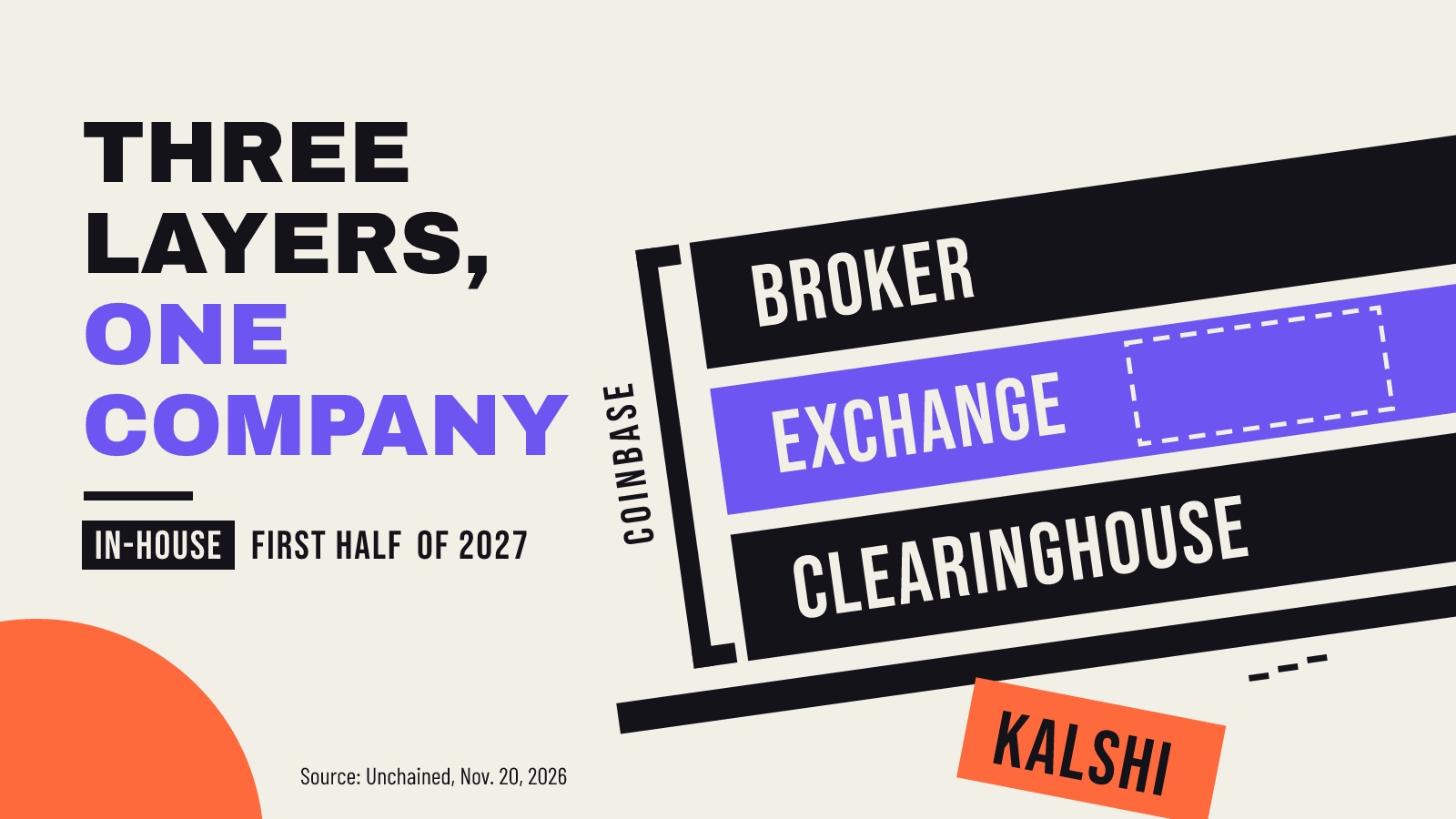
Coinbase wants to offer its own event contracts to American users in the first half of 2027, according to Unchained, which cited a Bloomberg story sourced to one person familiar with the plans. Today the contracts Coinbase customers trade come from Kalshi. This article looks at what changes when the app you trade on also writes the market, and where a small trader can lose money along the way.
What happened
The report says both retail and institutional traders would get access to the planned product. Coinbase has not confirmed the timeline. A spokesperson told Bloomberg the company had nothing new to announce and did not speak to timing.
The direction was already visible. On the Oct. 29 third-quarter earnings call, chief executive Brian Armstrong told investors: "we got CFTC approval to list our own prediction market contracts now, which will improve our economics". He did not give a date. The CFTC (Commodity Futures Trading Commission) is the U.S. agency that oversees derivatives markets.
Much of the machinery exists. Coinbase already runs a regulated derivatives exchange. On Dec. 22, 2025, it struck a deal to acquire The Clearing Company, a young prediction markets firm, and on Sept. 28 it won CFTC approval for its own clearinghouse, Coinbase Clearing LLC.
What are prediction markets?
Prediction markets let you trade event contracts: positions that pay out depending on whether a real-world outcome happens. Each contract is a simple yes or no question. If your side is right, the contract pays; if it is wrong, what you paid for it is gone.
The price of a contract moves as traders buy and sell, so you can also exit before the event is decided, at whatever price the market offers at that moment. That makes these products behave more like a traded derivative than a one-off bet.
The mechanics: why in-house matters
Today Coinbase acts mostly as a doorway. The contracts come from Kalshi. Moving contracts in-house would let Coinbase choose which markets to list and keep a bigger share of the fees, Unchained noted.
Three layers sit behind every event contract: the exchange that lists it, the clearinghouse that stands between buyers and sellers and makes sure the winner gets paid, and the broker that shows it to you. With its own exchange, its own clearinghouse and its own app, Coinbase could hold all three. That can make the product simpler to use. It also means one company decides what questions exist, how they are worded, and how the answer is judged.
The numbers show why the line matters. CFO Alesia Haas said prediction markets crossed $200 million of annualized run-rate revenue in the third quarter and called the line one of the fastest-growing new products. She added that the number of people placing prediction trades each day grew by more than 60% over the quarter. By Unchained's math, that pace works out to about $50 million a quarter, roughly 8% of the $590 million in third-quarter transaction revenue. According to Haas, the prediction and derivatives businesses combined brought in 25% of transaction revenue, and that prediction market growth offset weaker spot trading, leaving revenue flat quarter over quarter.
Where the risk is
None of this changes the basic payoff. It changes who sets the terms. A trader could lose money in several ways:
- All or nothing. A yes or no contract that settles against you is worth nothing. There is no partial recovery, and buying more to average down only raises the amount at stake.
- Thin new markets. A freshly listed question may have few buyers and sellers. A wide spread, the gap between the bid and the ask, means you pay more to get in and get less if you want out early.
- Wording and settlement. When the broker writes the question, the fine print decides what counts as yes. Read how and when a market is settled before you trade it.
- Legal uncertainty. Earlier this month a U.S. appeals court refused to pause state enforcement while appeals continue, against Kalshi in Connecticut and New York and against Coinbase in Connecticut. Where you live may affect what you can trade.
Fees deserve a separate look. A platform that earns more per contract has a reason to list more contracts and to make trading them feel effortless. That is not wrong in itself, but frequent small positions add up, and every round trip costs the spread plus any fee.
What to watch
First, whether Coinbase confirms a date. So far the only timeline comes from one unnamed source, as reported by Bloomberg and relayed by Unchained. Second, what happens to the Kalshi contracts already on the app, and whether both sets run side by side. Third, the state cases: the court rulings could shape where in-house contracts are offered at all.
If an in-house product does launch, compare the rulebook, the settlement source and the fee for each market before your first trade, the same way you would check any new derivatives venue.
Sources
- Unchained, 20 Nov 2026
Drafted with an AI model using only the sources listed, and released automatically after software checks on figures and originality. Nobody edited it by hand. For learning only; it does not tell you what to buy or sell.