Explainer · Markets & Macro
What moves exchange rates?
An exchange rate is just a price: the price of one currency in another. Like any price it moves with supply and demand, and central banks have described the main forces behind that demand fairly clearly. Predicting the next move is another matter.
Quick answer
In a floating system, exchange rates are set by supply and demand for currencies [2]. Over months, they reflect interest rate gaps between countries, competitiveness and each economy's outlook. Day to day, they can move on speculation, news and events [2].
Key points
- An AUD/USD rate of 0.75 means you get 75 US cents for each Australian dollar [2].
- The global FX market averaged $9.6 trillion of trading a day in April 2025 [3].
- Interest rate differentials are one of the medium-term drivers central banks name [2] [4].
- A stronger currency makes imports cheaper and can lower inflation [1].
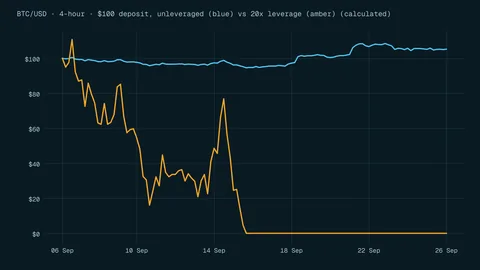
- With a 2% margin, a 1% move against a $100,000 position wipes out half of a $2,000 deposit (calculated).
On this page
What is an exchange rate and how do you read a quote?#
The European Central Bank defines an exchange rate as the rate at which one currency can be exchanged for another [1]. The Reserve Bank of Australia (RBA) puts it as the relative price of one currency in terms of another [2].
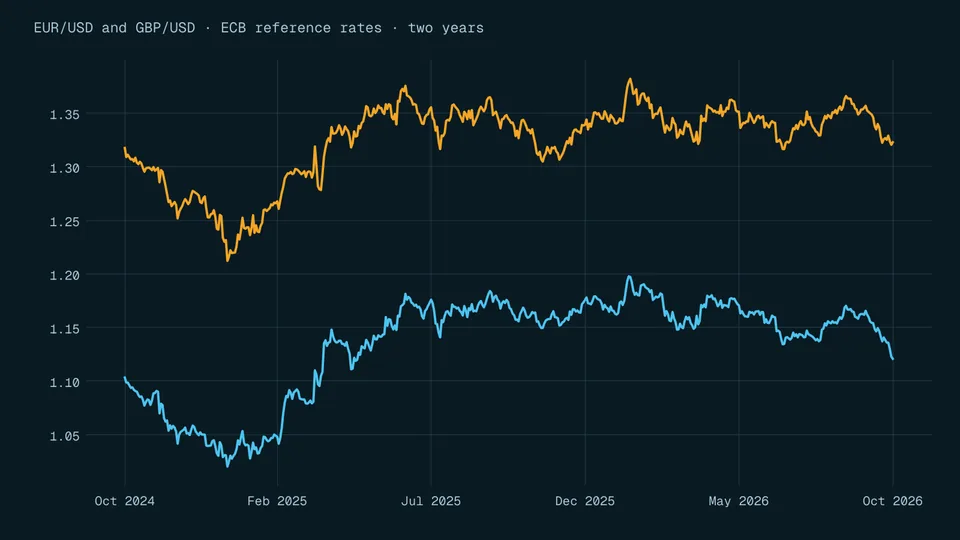
Currency pairs are written with two codes. The RBA's example: an AUD/USD rate of 0.75 means you get US75 cents for every Australian dollar converted [2]. The first currency is the one being priced, and the number tells you how much of the second currency one unit buys. The ECB's own illustration is €1 for $1.13 [1]. Both are teaching examples, not current rates.
Here is the RBA's 0.75 quote worked in both directions:
| What you do | Calculation | Result |
|---|---|---|
| Change AUD 1,000 into US dollars | 1,000 × 0.75 | USD 750 |
| Change USD 1,000 into Australian dollars | 1,000 / 0.75 | AUD 1,333.33 |
| Flip the quote to USD/AUD | 1 / 0.75 | 1.3333 |
Quote from the RBA example [2]; results calculated. Real conversions also include a spread and any fees, so you receive less than these figures.
Published reference rates are not always the price you can trade at. The ECB notes that its daily reference rates are averages of buying and selling rates and do not necessarily reflect actual transaction prices [1]. The gap between buying and selling is explained in our guide to the bid ask spread.
Who decides what a currency is worth?#
It depends on the system a country uses. In a floating regime, rates are generally determined by market supply and demand for foreign exchange; Australia, for example, has floated its currency since 1983. Under a pegged, or fixed, regime the monetary authority ties its official rate to another country's currency [2].
Even where a central bank is powerful, it may not aim at the exchange rate at all. The ECB states that the exchange rate is not one of its policy targets and that it does not try to influence it with its monetary policy operations [1].
The market itself is enormous. In April 2025, over-the-counter currency trading averaged $9.6 trillion a day, up 28% from $7.5 trillion three years earlier [3]. Spot trades, the simple exchange of one currency for another, were $3 trillion a day of that [3].
What moves exchange rates over months and years?#
The RBA names three medium-term drivers: changes in interest rate differentials, international competitiveness and the relative economic outlook of each economy [2].
Interest rate differentials. This is the gap between interest rates in two countries. The Fed explains that when US rates change, the relative attractiveness of US assets changes, and that moves exchange rates and the dollar [4]. The ECB likewise lists the exchange rate among the prices that can adjust after monetary policy actions [5]. For the full chain, see how interest rates affect markets.
Competitiveness. The RBA's second driver is international competitiveness [2]: in plain terms, how a country's goods and services compare with those of the countries it trades with.
Relative outlook. The third is the relative economic outlook in each economy [2]. The source does not say how much weight each driver carries.
Why do currencies jump on news from day to day?#
Over short periods the RBA says exchange rate movements may reflect speculation, or news and events that affect the economies involved [2]. Rates change constantly on global foreign exchange markets [1].
The 2025 BIS survey shows what that can look like. It was conducted in April 2025, amid elevated currency volatility and a surge in trading after trade policy announcements early that month [3]. As the US dollar weakened, many institutional investors holding dollar assets appear to have hedged to limit further currency losses [3]. The news came first; the volatility, the trading surge and the hedging followed.
How does a stronger or weaker currency reach everyday prices?#
Through imports. The ECB explains that when the euro rises against the dollar, US products become cheaper for people in the euro area, import prices fall, and that lowers inflation both directly and through cheaper imported raw materials [1]. The RBA describes the mirror image: a fall in a country's currency raises inflation, because goods produced overseas become relatively more expensive and because a weaker currency stimulates demand [6].
That feedback is one reason central banks watch exchange rates even when they do not target them. The ECB notes exchange-rate changes can affect inflation directly where imported goods are consumed [5]. Our guide what is CPI explains how that inflation is measured.
What does this mean if you want to trade currencies?#
Knowing what moves exchange rates does not tell you when or how far they will move, and retail forex accounts trade on margin, which creates leverage. The CFTC's example: a 2 percent margin requirement lets you open a $100,000 position with $2,000, and that leverage amplifies both gains and losses [7].
The official results are sobering. The CFTC says that about two-thirds of customers at registered US forex dealers lost money in data from Q2 2021 to Q1 2022 [7]. In a French study of 14,799 active individual forex and CFD investors over four years, from 2009 to 2012, 89% lost money [8].
- Learn the mechanics first
Read leverage and margin explained so you know how a small move becomes a large share of your deposit.
- Decide the most you can lose
Use only money you can afford to lose, and size each trade from that amount with position sizing.
- Count the costs
Spreads and fees come off every trade, and the CFTC notes that most customers lose money once fees, financing charges and other costs are counted [7].
Mistakes beginners make with exchange rates#
- Reading the quote upside down
AUD/USD 0.75 prices the Australian dollar in US dollars, not the other way round [2]. Flipped, it is 1.3333 (calculated).
- Treating one driver as the whole story
Interest rates matter, but the RBA also lists competitiveness, the economic outlook, speculation and news [2].
- Assuming every central bank steers its currency
The ECB states that the exchange rate is not one of its policy targets [1].
- Using a reference rate as a trading price
Reference rates are averages of buying and selling rates, not necessarily prices anyone traded at [1].
- Underestimating leverage
At 2% margin, a 2% move against you can erase the whole deposit (calculated), and losses can exceed it [7].
Frequently asked questions#
What is the main thing that moves exchange rates?
There is no single one. Over months, the RBA points to interest rate differentials, competitiveness and the relative economic outlook; day to day, to speculation, news and events [2].
Why does a currency often rise when interest rates go up?
Higher rates can make assets in that currency more attractive, and the Fed says such changes move exchange rates [4]. It is a tendency, and other news can outweigh it.
How big is the foreign exchange market?
The BIS Triennial Survey found average turnover of $9.6 trillion a day in April 2025, with the US dollar on one side of 89.2% of trades [3].
Is a strong currency good or bad?
It depends who you are. A stronger currency makes imports cheaper and can lower inflation [1], and by the same arithmetic it makes the country's own goods dearer for foreign buyers.
The bottom line#
Exchange rates are prices set by supply and demand, and central banks describe the main forces clearly: interest rate gaps, competitiveness and the economic outlook over months, and speculation, news and events from day to day. None of that tells you the next move. If you trade currencies, the leverage involved means a move of 1% or 2% can take half or all of a small deposit, and official studies show most retail traders lose. Read our risk disclosure before you start.
Sources
- What is the role of exchange rates?.
- Exchange Rates and their Measurement.
- OTC foreign exchange turnover in April 2025.
- Monetary Policy: What Are Its Goals? How Does It Work?.
- Transmission mechanism of monetary policy.
- Causes of Inflation.
- Customer Advisory: Eight Things You Should Know Before Trading Forex.
- Perspectives on the techniques used to market speculative trading on the Forex and binary options markets.
- Meeting calendars and information.
- Schedule of Releases for the Consumer Price Index.
Education only. This page is not investment, tax or legal advice. Trading and crypto can lose you money. See our risk disclosure.