News analysis ·
Prediction Markets on Drug Trials: The Insider Risk
Two senators questioned HHS over event contracts on drug trials and FDA approvals. We explain how these contracts work and who carries the risk.
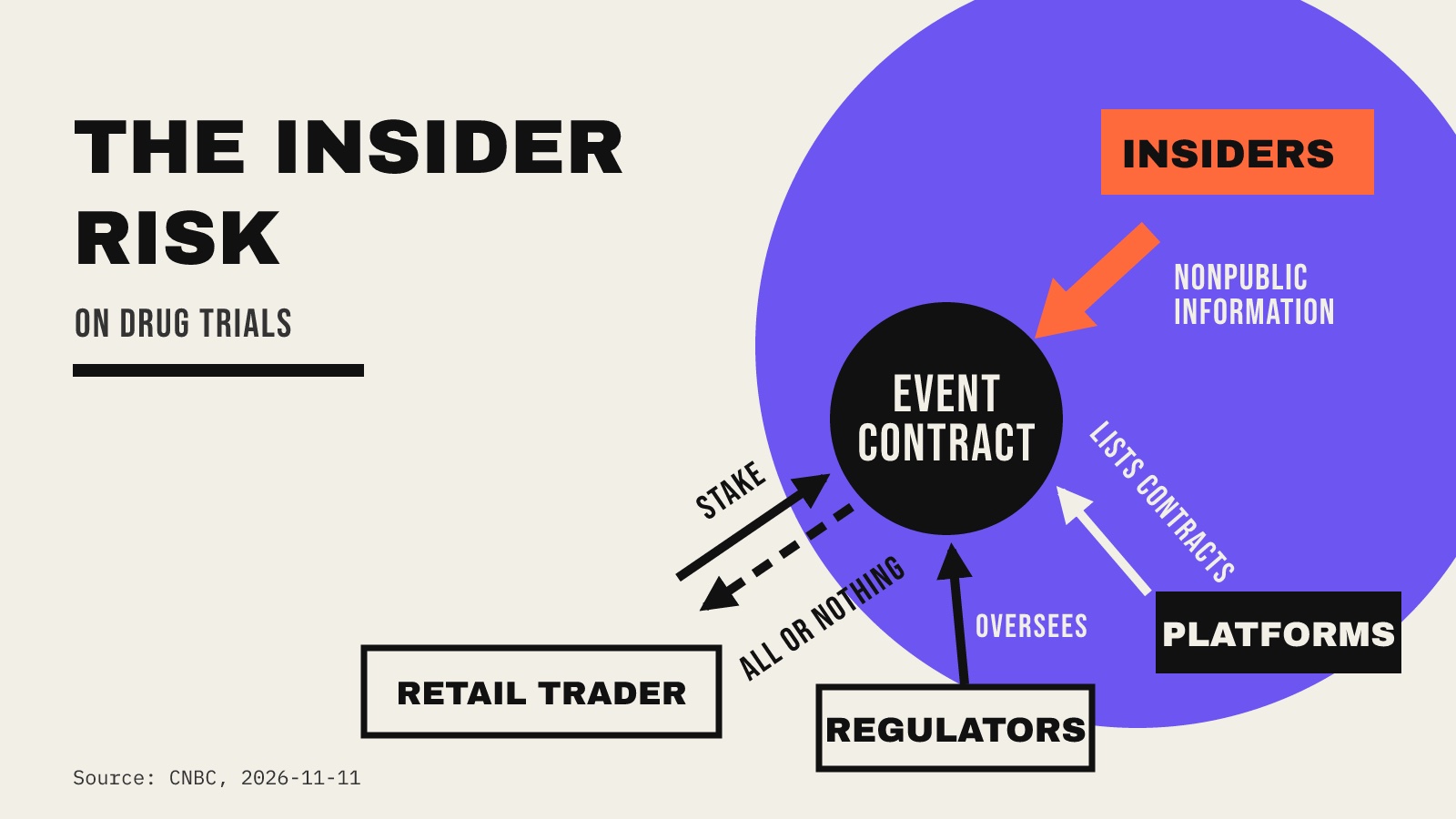
Two Democratic senators have asked the Department of Health and Human Services what it is doing about prediction market contracts that let people bet on clinical drug trials and FDA approval decisions, CNBC reported. The letter focuses on patients, scientists and insider trading. This article looks at the same contracts from the trader's side: how they pay out, who might be on the other side of your trade, and where the money can be lost.
What happened
Sen. Angela Alsobrooks of Maryland and Sen. Ron Wyden of Oregon sent the letter on Wednesday to Robert F. Kennedy Jr., who leads HHS. CNBC said it obtained the letter first. The senators asked what steps the department has taken to limit the risks these markets create.
Their concerns are broad. They argue that wagering on trial and drug outcomes can damage the scientific process, give researchers bad incentives and harm trial participants. They repeated worries from some healthcare professionals that the markets could change how patients decide whether to join a trial. They also raised insider trading, because researchers and regulators can hold nonpublic information about results and approval decisions.
The senators asked HHS for internal messages about staff trading on prediction markets tied to matters the department oversees. They also want its communications with the platforms and with the Commodity Futures Trading Commission, the regulator of event contracts, plus any internal studies of the impact. HHS and Polymarket did not immediately respond to CNBC. CNBC disclosed that it has a commercial relationship with Kalshi, including customer acquisition and a minority investment.
What are prediction markets on drug trials?
A prediction market lists contracts on a yes-or-no question, such as whether a drug wins approval or a trial hits its goal. If the event happens, the yes side receives a fixed payout. If it does not, the yes side gets nothing. According to CNBC, both Kalshi and Polymarket offer contracts tied to drug trials and FDA decisions, though Polymarket lists them only on its international exchange, which is not regulated in the U.S.
Kalshi opened its drug markets in July. At launch, Kalshi promised to list markets only on late-stage trials, to open a contract only after a trial finished enrolling patients, and to run employee verification checks on every trader in these markets. Kalshi CEO Tarek Mansour defended the idea at launch: "Drug development is one of the most important and most information-constrained industries on earth".
The mechanics: a binary bet against better-informed people
The price of a contract works like the crowd's estimate of the odds. A cheap yes contract means the market thinks approval is unlikely. You can buy, hold to the outcome, or sell early to someone else at whatever price the market offers that day.
Two features matter most for a retail trader. First, the payoff is all or nothing. There is no partial credit if a trial almost succeeds; the losing side loses its whole stake on the day the result is settled. Second, every contract has a buyer and a seller. When you buy yes, someone else is taking the no side, and you rarely know who they are or what they know.
This is the heart of the insider trading point in the senators' letter. In a market about a public sports game, most traders see the same information. In a market about an unpublished trial result or a pending regulatory decision, a small group of people may already know the answer. Kalshi's guardrails, such as identity checks and waiting until enrollment closes, are designed to narrow that gap. They cannot remove it.
Where the risk is
For a trader, losses can come from several directions.
- Information gap: the person selling you a contract may know more about the trial or the decision than any public report, so you may be buying at a price that informed traders already know is wrong.
- Total loss on settlement: a binary contract on the wrong side pays nothing, so a single surprise outcome can wipe out the full amount staked.
- Thin trading: niche markets on one drug may have few buyers and sellers, so getting out early can mean accepting a much worse price than the last trade.
- Venue risk: Polymarket lists these contracts only on its international exchange, which lacks U.S. regulation, so the protections and dispute routes may differ from a venue under U.S. rules.
Kalshi argues these risks are not unique. It pointed out that investors already buy biotech and pharmaceutical stocks whose fate depends on pending approvals. Spokesperson Jack Such told CNBC that the senators' worries apply just as much to the stock market, where he said the size of trading and the incentive for bad behavior are far larger. That comparison is fair as far as it goes, but a share can keep some value after bad news, while a losing binary contract goes to zero.
What to watch
Watch whether HHS answers the letter and what it says about staff trading rules. Any move by the Commodity Futures Trading Commission would matter more for traders than political statements. Also watch whether platforms change the guardrails Kalshi described in July, and whether more of these markets appear outside U.S. oversight.
Sources
- CNBC, 11 Nov 2026
Drafted with an AI model using only the sources listed, and released automatically after software checks on figures and originality. Nobody edited it by hand. For learning only; it does not tell you what to buy or sell.