News analysis ·
Prediction Market Geofencing: CFTC Order vs Courts
Senators want the CFTC to withdraw its order ending state location blocks on prediction markets. What it means for access, contracts and trader risk.
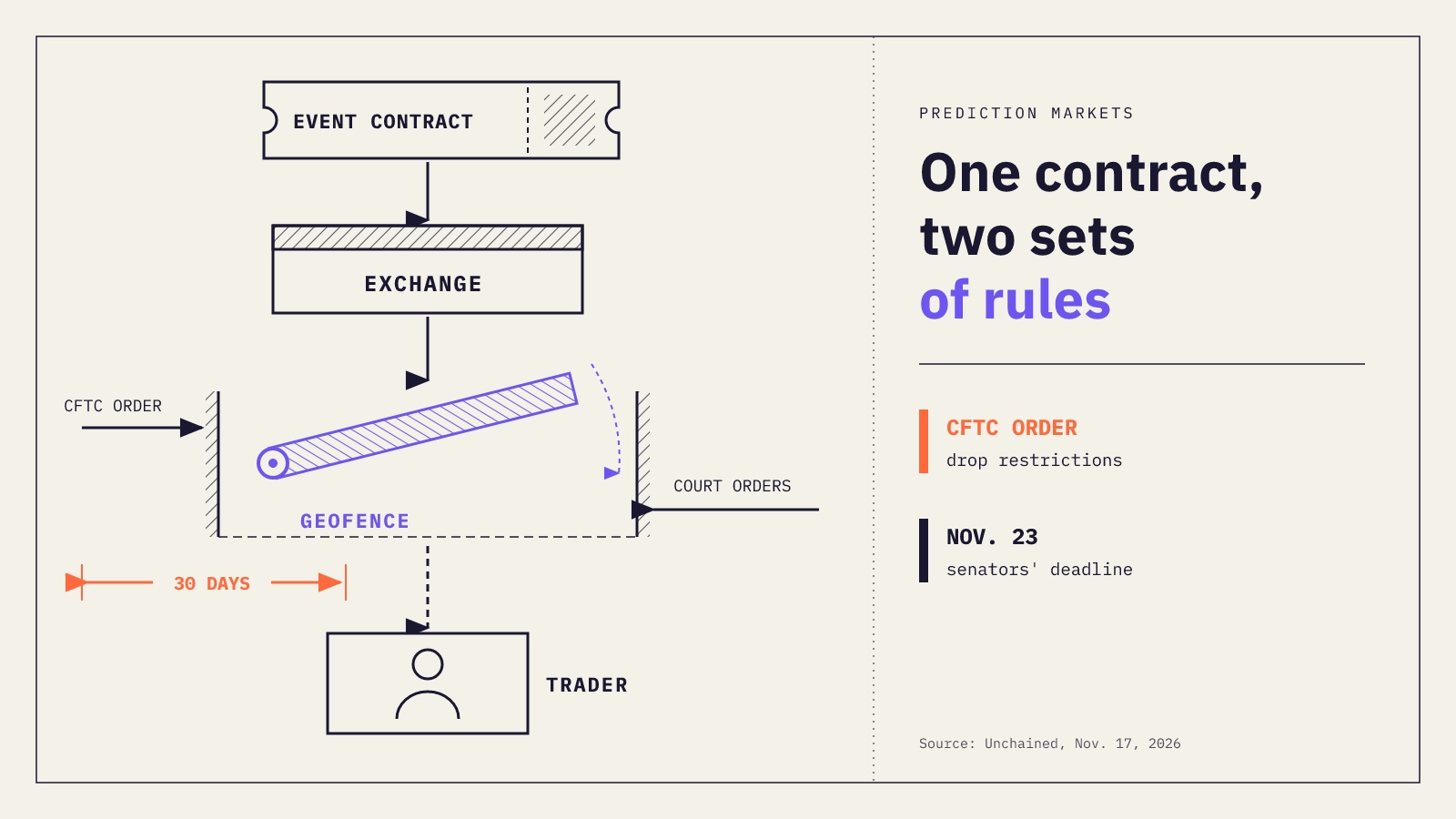
Sen. Adam Schiff and eight other Democratic senators have asked the Commodity Futures Trading Commission to take back an order from Nov. 5 that would end state-by-state blocking on prediction market exchanges, Unchained reported. This article looks at what that tug of war means for a trader who can open an event contract today and may not be able to keep it tomorrow.
What happened
On Nov. 5 the CFTC, the federal regulator for derivatives, issued an interpretation of its impartial access rule. That rule says designated contract markets, the federally registered venues where event contracts trade, must give fair and open access. Under the new reading, these exchanges have 30 days to drop domestic geographic restrictions, or give the Division of Market Oversight their reasons for keeping them. CFTC Chairman Michael Selig argued that derivatives venues need to run uniformly on a national scale.
The senators answered with a letter dated Nov. 16. According to Unchained, they wrote that the order "directly conflicts with active court orders, undermines state and tribal law, and must be reversed." Amy Klobuchar, the top Democrat on the Senate Agriculture Committee, also signed the letter, as did Jacky Rosen, Catherine Cortez Masto, Alex Padilla, Maria Cantwell, Patty Murray, Elissa Slotkin and Gary Peters.
What are prediction markets, and why location matters
A prediction market lets you buy a contract that pays out if a stated event happens, such as the result of a game or an election. Federally registered exchanges treat these as derivatives. Many states see some of them, sports contracts above all, as gambling under state law.
That clash is why location matters. Geofencing means shutting a user out because of their physical location. It has been the main way platforms obeyed state demands, for example when Michigan and other states moved against sports contracts. The senators point to rulings from the Sixth and Ninth Circuit appeals courts finding that state gambling law still applies to prediction markets. They say courts in Michigan, Nevada and Washington, plus disputes brought by two California tribes, ordered some contracts removed.
The mechanics: one contract, two sets of rules
For a trader, the geofence is the switch that decides whether a market appears in the app at all. If a federal order says the switch must be off and a court says it must be on, the exchange has to pick which instruction to follow, and either choice can be challenged.
The senators say the timing makes this sharper. According to the letter, a Northern California federal judge had told Kalshi only hours earlier to geofence tribal territory in the Blue Lake Rancheria v. Kalshi case, before the CFTC acted. The letter suggests the agency may be coordinating with platforms in litigation and nudging them to defy state and tribal gaming laws. The CFTC, for its part, is on the offensive: by its own account, it filed suit alongside the Justice Department against Arkansas once that state's attorney general went after Kalshi, then against Louisiana on Nov. 13. Selig posted on X on Nov. 16, without referencing the letter, that he would not let states sue CFTC exchanges unchecked.
The practical point: access to an event contract is not a fixed feature of the product. It rests on rules being fought over in real time.
Where the risk is
These risks are not about whether your forecast is right. They are about the venue and the law around it.
- Sudden loss of access: if a market opens in your state because of the federal order and a court later forces the block back, you may be limited to closing positions, or the contract may be pulled.
- Thin exit liquidity: when a contract is withdrawn in some places, fewer people can trade it, so the price you can sell at may be worse than the last quote you saw.
- Legal grey zone for the user: a trade that the exchange allows is not the same as a trade your state accepts, and the courts are still deciding where that line sits.
- Platform disputes: an exchange caught between a regulator and a judge can face penalties or injunctions, and its users absorb the disruption when it changes rules or freezes markets.
A simple habit helps: before you trade an event contract, check where the exchange is registered, which states or areas it blocks, and what its terms say happens to open positions if a market is removed.
What to watch
First, the senators want the interpretation withdrawn, or at least paused while the lawsuits continue. Failing that, they ask the CFTC to state plainly that three types of location block remain permitted: those a judge orders, those needed under a tribal-state compact or the Indian Gaming Regulatory Act, and voluntary blocks a platform sets for itself. They want the CFTC to hold on to records dating from Jan. 1, 2025, and they set Nov. 23 as the deadline for an answer.
Watch whether the CFTC answers by that date, how exchanges handle the 30-day window, and whether courts treat lifting a geofence as defying their orders.
Sources
- Unchained, 17 Nov 2026
Drafted with an AI model using only the sources listed, and released automatically after software checks on figures and originality. Nobody edited it by hand. For learning only; it does not tell you what to buy or sell.