News analysis ·
Itau's crypto filing: what Brazil's rules mean for you
Itau filed its crypto broker notice with Brazil's central bank. What the BCB 520 rules mean for bank crypto clients, and the 30-day wind-down risk.
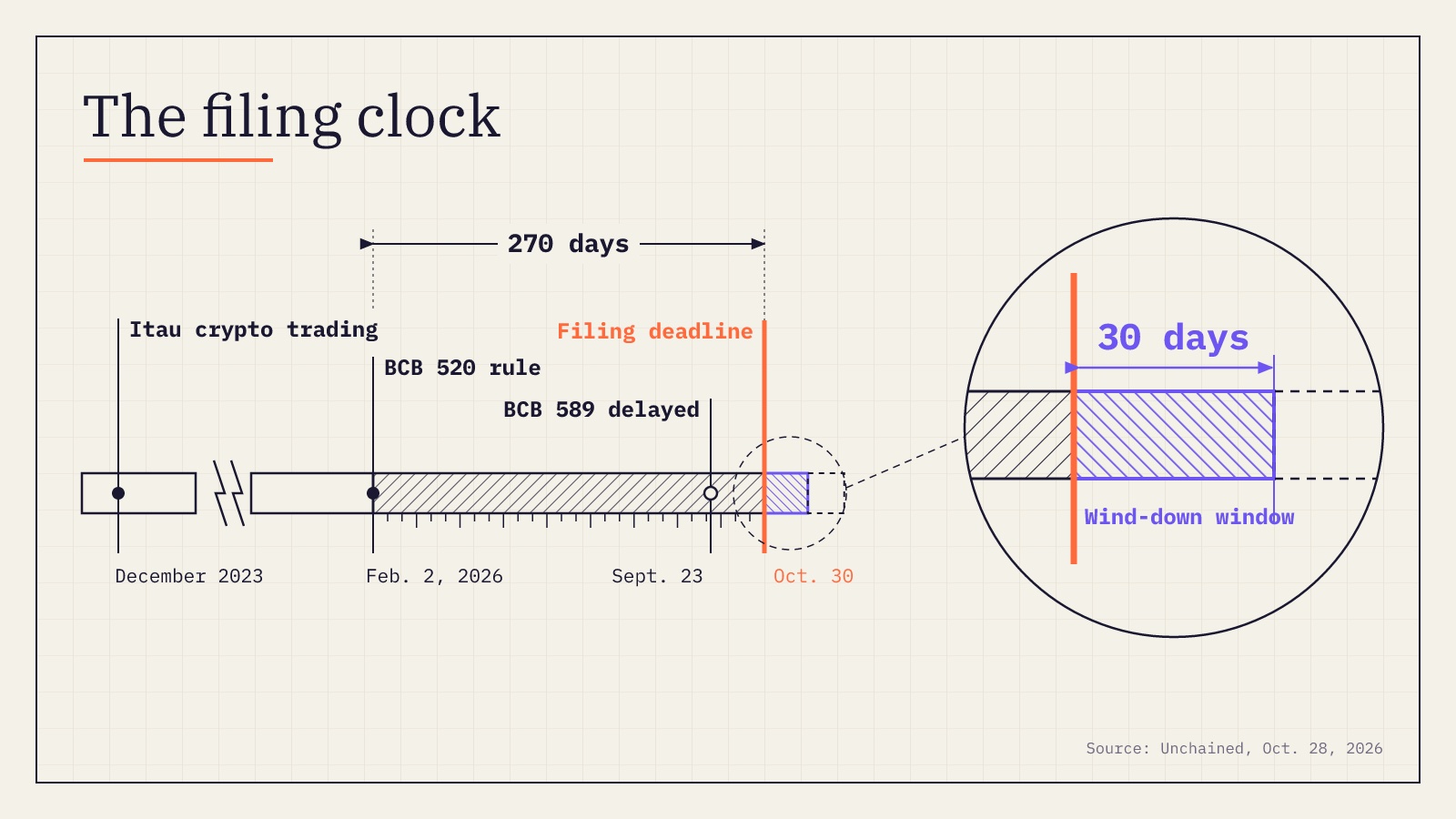
Itau Unibanco has formally told Brazil's central bank that it runs a crypto broker business, Unchained reported on Oct. 28, citing Valor Economico. The notice landed on Oct. 27, three days ahead of the cutoff that applies to supervised banks already active in crypto. This article looks at what a bank-run crypto service actually promises a customer under Brazil's new rules, and where the risk still sits.
What happened
Itau's crypto trading service for its clients dates back to December 2023. Its menu today runs to more than 14 coins and tokens, among them bitcoin, ether and the stablecoin USDC, and it holds them in custody for clients. Custody simply means the bank keeps the coins on your behalf, so you never manage a private key yourself.
Brazil's rules treat that pairing, trading plus safekeeping, as a broker activity. The rulebook is called Resolution BCB 520. Independent crypto firms must apply for authorization under it. Banks and brokers the central bank already supervises take a lighter route: they file a notice. Any of them already offering crypto when the rule took force, which was Feb. 2, 2026, got a 270-day window to file, ending Oct. 30. Itau filed inside that window.
Guto Antunes, Itau's superintendent of digital assets, said the bank put client security first from the start and that clear, high-standard rules help the industry and, above all, consumers. According to Unchained, Itau does not publish its crypto client numbers or trading volumes.
What the rules check when a bank holds your crypto
Buying crypto through a bank looks like buying it through an exchange. You place an order and the bank fills it. The difference is who stands behind the service. A bank that files under BCB 520 must attach a technical certification from an independent firm saying it meets the resolution's requirements.
That is a real hurdle, but it is a notice, not a finished approval. The central bank can ask for more information. It can also tell a bank to close its crypto business, with a 30-day deadline once the bank is informed. A sloppy filing is one possible trigger. A bank that misses the deadline altogether gets just 30 days of continued crypto service before it must stop.
The mechanics: a 30-day clock on your account
Here is the part most customers never read. If a regulator tells a broker to stop, the broker does not freeze prices for you. It has a short window to close its crypto business, and every client is trying to exit through the same door at the same time.
Think through what that means in practice. Within that window you may have to choose between selling at whatever the market pays that week or moving your coins elsewhere, if the provider allows transfers out at all. Crypto prices can swing hard in a month. A forced exit date takes away your choice of timing, and a small investor has few other tools.
The rules also change who a bank may trade with. Starting Nov. 6, any firm holding a central bank license is barred from executing or helping to arrange crypto trades with an unauthorized provider on the other side, outside the exceptions the resolution lists. The ban was originally scheduled for Oct. 30, until a follow-up rule, Resolution BCB 589 from Sept. 23, delayed it by one week. If your bank relied on an unauthorized partner for prices or liquidity, that route closes.
Where the risk is
A familiar bank name lowers some risks, not all of them. Concrete ways a customer could still lose money:
- Forced selling: a 30-day wind-down order could push you to sell into a falling market rather than when you choose.
- Transfer limits: if a custodial service does not let you withdraw coins to your own wallet, selling may be the only exit.
- Missing data: with no published client or volume figures, you cannot judge how crowded the exit would be.
- Price risk is unchanged: a bank wrapper does not make bitcoin, ether or any other coin less volatile.
Stablecoins such as USDC carry their own issuer risk, which a bank's custody does not remove. Custody protects against losing a key, not against the asset itself.
What to watch
Oct. 30 is also the last day for independent crypto exchanges to apply for permission to operate. Unchained reported that Binance had already stopped Brazilian users from opening new loans and margin trading before that cutoff. Products like these can disappear quickly when rules tighten, so leveraged positions are the first to feel it.
After the deadlines pass, watch for central bank requests for more information or any wind-down orders, and check whether your provider is on the authorized side of the Nov. 6 line. Before using any bank or exchange for crypto, read what happens to your coins if it is told to stop, and whether you can move them out.
Sources
- Unchained, 28 Oct 2026
Drafted with an AI model using only the sources listed, and released automatically after software checks on figures and originality. Nobody edited it by hand. For learning only; it does not tell you what to buy or sell.