Calculator
Risk reward calculator
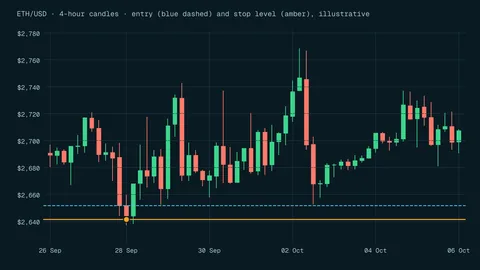
Enter where you get in, where your stop is and where you plan to take profit. The calculator returns the reward-to-risk ratio, the win rate you need just to break even, and the average result per trade at the win rate you enter.
Quick answer
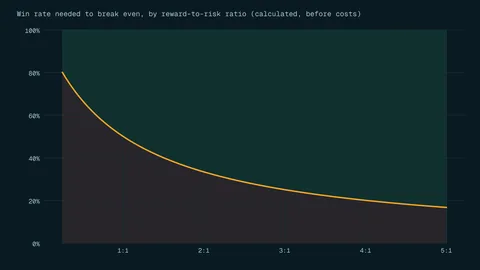
Ratio = (target - entry) / (entry - stop). Break-even win rate = 1 / (1 + ratio). Entry $100, stop $95 and target $110 give 2:1, so you must win more than 33.3% of trades before costs (calculated). Stops can fill worse than planned [1].
This calculator needs JavaScript. The formula and a worked example below show the same calculation by hand.
Key points
- The ratio describes one plan. Only your measured win rate says whether the plan can break even.
- Break-even win rate = 1 / (1 + ratio): 50% at 1:1, 33.3% at 2:1, 25% at 3:1 (calculated).
- Costs and slippage lower the real ratio, so the true break-even is higher than shown [4].
On this page
How does the calculator work?#
It measures two distances. Risk is the distance from your entry to your stop, which is what one unit loses if the stop fills at its price. Reward is the distance from your entry to your target. Dividing reward by risk gives the ratio. It uses the size of each distance, so it works for short trades too, where the stop sits above the entry and the target below.
ratio = |target - entry| / |entry - stop|
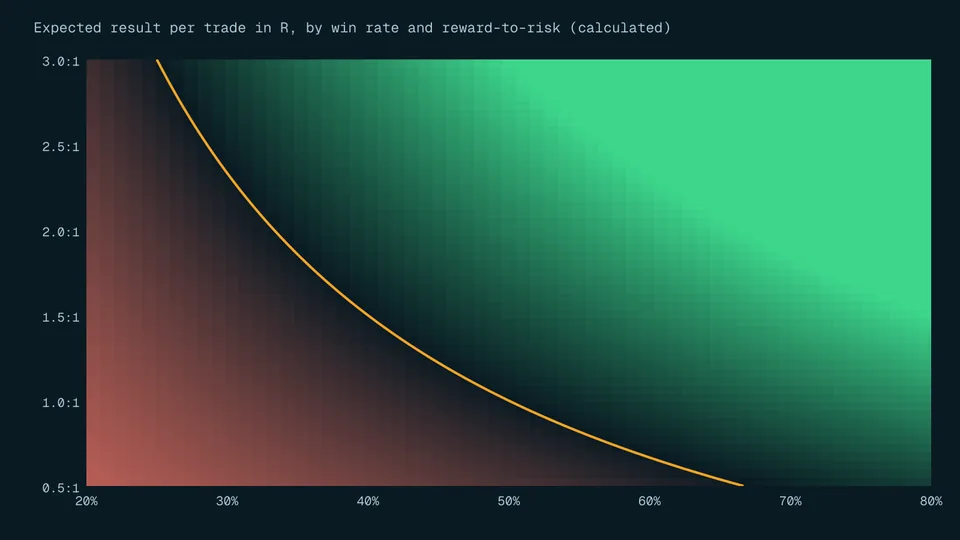
From the ratio it works out the share of trades you must win so that wins and losses cancel out. Then, using the win rate you enter, it calculates expectancy: the average result per trade in R, where 1R is the amount you risk on one trade.
break-even win rate = 1 / (1 + ratio)
expectancy (R per trade) = win rate × ratio - (1 - win rate)
Can you check the result by hand?#
| Target | Ratio | Break-even win rate | Expectancy at 40% |
|---|---|---|---|
| $105 | 1 : 1 | 50% | -0.2R |
| $107.50 | 1.5 : 1 | 40% | 0R |
| $110 | 2 : 1 | 33.3% | +0.2R |
| $115 | 3 : 1 | 25% | +0.6R |
| $120 | 4 : 1 | 20% | +1R |
The table keeps the win rate fixed at 40% to show the arithmetic. In practice a more distant target is reached less often, so the win rate would not stay the same.
What does the calculator not account for?#
- Stops that fill worse than planned. When the stop price is reached, a stop order becomes a market order and the price can deviate significantly from the stop [1]. If the $95 stop fills at $93, the real ratio falls to about 1.43:1 and break-even rises to 41.2% (calculated).
- Costs. Spreads, commissions and financing come off every win and add to every loss. The SEC advises day traders to know how much they need to make to cover expenses and break even [2]. Estimate yours with the trading cost calculator.
- Whether the target is realistic. The calculator accepts any target. It cannot tell you how often price actually gets there.
- Where your win rate comes from. It should be measured from your own closed trades. A guessed win rate gives a guessed answer.
How do you get a win rate you can trust?#
Count it from records, not memory. Log every closed trade in a journal or a demo account, then divide wins by all trades. Small samples mislead: 8 wins out of 20 trades is a 40% win rate, but the plausible true rate (a 95% Wilson interval) still runs from about 21.9% to 61.3% (calculated). That range includes plans that lose money at 2:1.
Read the full explanation, including costs, losing streaks and the official data on retail traders, in risk reward ratio and win rate, together. To turn the risk side of the plan into a number of units, use the position size calculator.
Frequently asked questions#
What is a good risk/reward ratio?
None is good on its own. A ratio only works together with the win rate you actually achieve. At 1:1 you must win more than half of your trades; at 3:1 more than a quarter, before costs (calculated).
What does "R per trade" mean?
R is the amount you risk on one trade. An expectancy of 0.2R means that, on average over many trades, each trade would add 20% of the amount risked, if your inputs held. With $100 risked, that is $20 before costs.
Does this work for short trades?
Yes. Enter a stop above your entry and a target below it. The calculator uses the size of each distance, so the ratio comes out the same way.
Why is my real break-even win rate higher than the calculator shows?
Because the calculator assumes your stop fills exactly at its price and ignores costs. FINRA states that stop prices are not guaranteed execution prices [4], and every cost makes wins smaller and losses bigger.
The bottom line#
Use the calculator to see what a trade plan asks of you before you place it: the ratio, the win rate it needs and the average result at the win rate you have actually measured. Plan with worse fills and real costs, not the neat numbers. For the reasoning, read risk reward ratio and win rate, together and the other risk management explainers, and read the risk disclosure before trading.
Sources
Education only. This page is not investment, tax or legal advice. Trading and crypto can lose you money. See our risk disclosure.